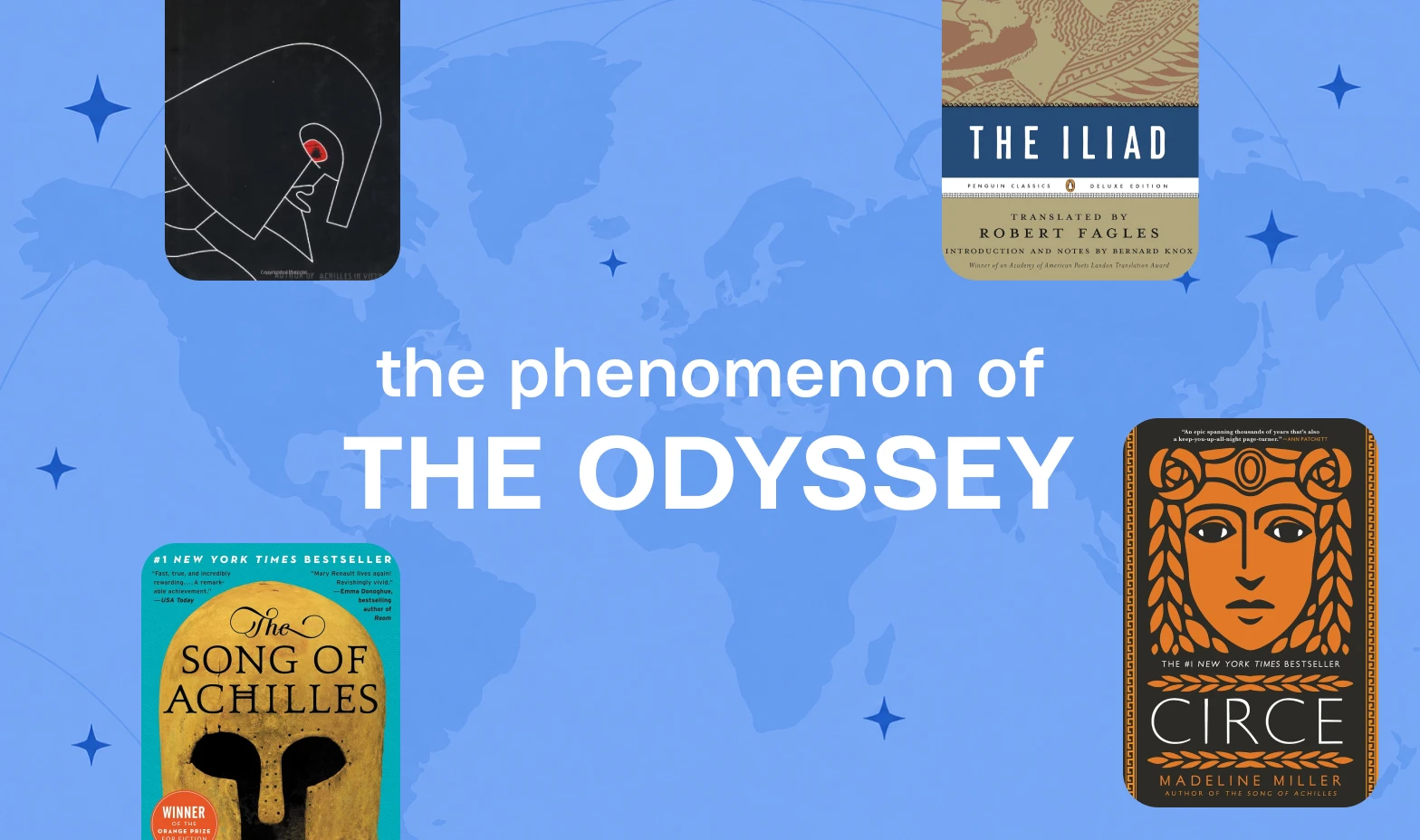
Whether you’re coming to the Odyssey for the first time because of Christopher Nolan’s blockbuster, returning to it after many years, or simply trying to understand why writers and filmmakers keep circling the same ancient story, you’ll find what you need here. AdvanceMe team has prepared a short outline of:
- the film’s most striking details;
- the best translations;
- the poem’s peculiarities;
- a curated reading list of classics and modern books similar to the Odyssey.
What is The Odyssey?
Homer’s Odyssey is an ancient Greek epic poem composed around the 8th century BCE, traditionally attributed to the blind poet Homer. We won’t go deep into the plot because you being here is the sign that you already know the basics about The Odyssey and still want to learn more.
What is worth mentioning is that the Iliad and the Odyssey together form the foundation of Western literary tradition. The Iliad is about war, rage, and the waste of human life on a battlefield. The Odyssey is about the trials and tribulations of getting home, and what it means when home has changed in your absence. If you’re curious about ancient times, we recommend reading our summary of 24 Hours in Ancient Athens.
The Odyssey that went viral and the one that laid the foundations
On July 17, 2026, Christopher Nolan released his adaptation of the Odyssey. It’s a $250 million IMAX epic that became, almost immediately, one of the most discussed films of the year. Nolan arrived at this project with both extraordinary resources and extraordinary expectations. By most accounts, he met them. There are a few things that have made this film so special:
- Cast. Matt Damon stars as Odysseus, with Anne Hathaway as Penelope, Tom Holland as Telemachus, Zendaya as Athena, Robert Pattinson as the suitor Antinous, and Lupita Nyong’o as Helen of Troy, with Charlize Theron as the sea nymph Calypso.
- Location. There are multiple locations: Italy, Iceland, Greece, Morocco, and Scotland. The specific locations, including the Castle of Santa Caterina and the Moray Firth inlet, are sure to take the viewer’s breath away.
- Filmmaking craft. The Odyssey is shot using brand new IMAX film technology. What’s so special about it is that it required moving 400-pound equipment across oceans and deserts. Besides, in pursuit of tactile realism, Nolan avoided CGI green screens, using backing paintings and inventing a new lighting system called “pyrohedrons.”
For our team and, hopefully, readers, this film has also become a way to recall the classics, rethink the classics, compare it to the film, and realize its importance.
A man who has been through bitter experiences and travelled far enjoys even his sufferings after a time.
— Homer, The Odyssey
The translations worth reading
As the saying goes, “There is nothing new under the sun.” Even though Nolan’s film is unique and breathtaking, it reinterprets the same old story. If you want to read The Odyssey after watching a film, these days you have a few options in English. Among them, we’ve picked three for you.
The Odyssey translation by Robert Fagles (1996) is the classic. It’s poetic, energetic, readable, and often assigned in schools and universities. This is the version that most generations of English-language readers have used as their standard encounter with Homer.
The translation of the Odyssey by Emily Wilson (2017) is widely praised as modern, vibrant, and sometimes wry. Wilson is the first woman to translate it. After returning to Homer’s more direct, unvarnished language, she filled her work with unusual freshness. It is the translation most likely to make you feel like you are reading something genuinely new.
E.V. Rieu’s translation of the Odyssey is the version Nolan himself consulted during production. It’s a more novelistic, prose-based reading of the poem, which some readers find more accessible.
No matter which one you choose, reading classics makes you understand the tricks authors use even now to captivate their readers.
What makes The Odyssey so irresistible
So, why does this poem keep producing new versions? Why do novelists, science fiction writers, feminist poets, and Hollywood directors all keep returning to this old story?
Let’s consider its beginning. Homer’s Odyssey starts in the middle of the action. Odysseus has been stuck on Calypso’s island for seven years, the war is long over, and his son is already grown before the poem begins. This in medias res opening plunges the reader immediately into crisis, then uses flashbacks and embedded stories to reveal the past. Sounds familiar? This is the dominant structure of modern cinema and much of literary fiction. However, Homer got there first.
The poem also uses what scholars call the interlace technique. Simply put, it runs three storylines simultaneously — Odysseus wandering, Telemachus searching, Penelope enduring. Simultaneously, the narratives maintain a “continuity of time” where events unfold in parallel rather than sequence. Take, for example, The Wire, Game of Thrones, The Bear. All of them are doing something Homer was doing in the 8th century BCE.
Once we move from the structure to the themes, everything becomes even more complicated. Should Odysseus’s adventures be taken literally or...? Circe’s island, the Cyclops, the trip to the underworld could be a way for him to explain the trauma of war to people who’ve never experienced it. The monsters stand in for the battlefield. The magic reflects how the mind copes and disconnects. In that sense, the poem shows a deep understanding of trauma and returning home.
And beneath all that is something very familiar, something everybody can relate to: family life. A husband, a wife, a son, and twenty years apart. The real question is whether they’re still the same people they used to be.
What you should read after The Odyssey
The classics:
Start with the prequel, which is Homer’s Iliad. It is focused entirely on a few weeks during the final year of the Trojan War, centering on the wrath of Achilles after Agamemnon dishonors him and the catastrophic consequences that follow. Together, the two poems give you the full arc, with The Iliad depicting the war that made Odysseus who he is.

The Iliad
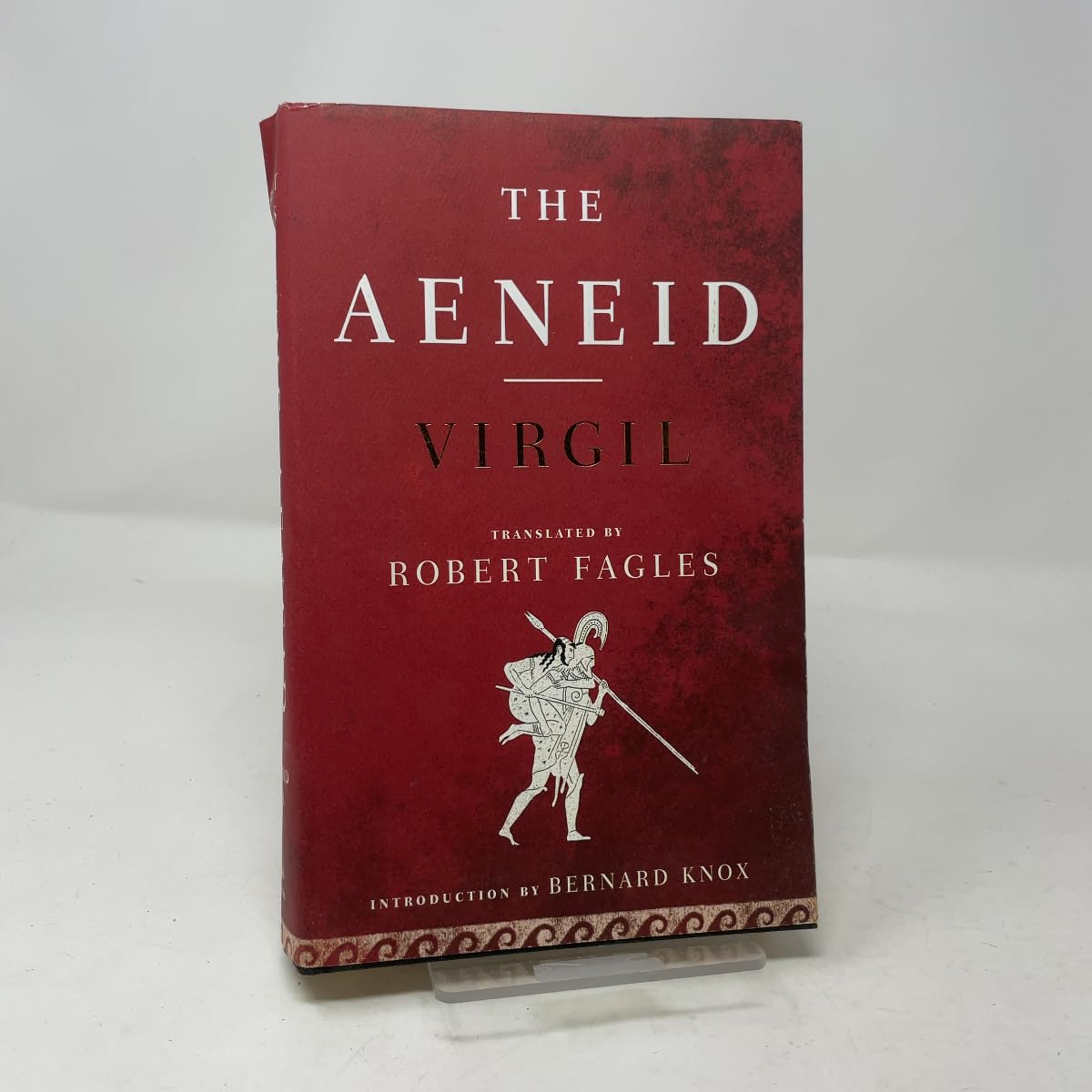
You can also read Rome’s answer to Homer — The Aeneid by Virgil. It borrows extensively from The Odyssey’s structure, like sea voyages, divine interference, and a descent to the underworld. What differs is the journey reframed as one of duty rather than homecoming.
The Aeneid
If what attracts you to the Odyssey is mythology, then Metamorphoses by Ovid is an obvious must-read for you. It’s basically a massive Roman collection of over 250 transformation myths. Metamorphoses is one of the primary sources through which Greek mythology reached Renaissance Europe and eventually the modern world.

Metamorphoses
Finally, you can choose to read something less ancient, like Ulysses by James Joyce. It’s considered the most famous literary reimagining of The Odyssey in modern literature. Joyce transposes the entire poem onto a single day in Dublin in 1904. The story follows the parallel journeys of Leopold Bloom (Odysseus), his wife Molly (Penelope), and the young Stephen Dedalus (Telemachus) through the streets of the city. Although it is deliberately difficult, it’s worth the effort for readers willing to commit.

Ulysses
Modern fiction titles:
Circe (2018) by Madeline Miller
The novel follows Circe from her origins as an awkward daughter of the sun god Helios through her exile, her encounters with figures from across Greek mythology, and her final realization of her own power. This is the story of the person Homer barely noticed, in the same world, with the same mythological logic, and the same epic scope.

Circe
The Song of Achilles (2011) by Madeline Miller
For readers who want books similar to the Odyssey, it’s yet another story by Madeline Miller. It does for The Iliad what Circe does for The Odyssey: it relocates the story inside a character Homer keeps at the margins. Patroclus — Achilles’ closest companion — narrates the years leading up to the Trojan War and the war itself.

The Song of Achilles
The Penelopiad (2005) by Margaret Atwood
This story is narrated by Penelope herself from the underworld, alongside the twelve maids who were hanged at the end of the Odyssey. Although Homer passes over this detail in fewer than ten lines, Atwood doesn’t. The maids form a Greek chorus, performing their own account of what happened and why. It is one of the most pointed feminist responses to Homer in literature.

The Penelopiad
Percy Jackson and the Olympians (2005–2009) by Rick Riordan
Riordan’s series about Percy Jackson, son of Poseidon, introduced an entire generation to the mythology underlying Homer’s Odyssey. If you are looking for something more playful, fast, and genuinely funny, check out the first book in the series full of dangerous mythological obstacles.

Percy Jackson and the Olympians
If you are more into non-fiction:
Odysseus in America (2002) by Jonathan Shay
This book, written by a VA psychiatrist, shows that The Odyssey is much more than an adventure story. The author draws detailed parallels between Odysseus’s experiences, e.g., the inability to return home psychologically, the rage, the dissociation, the disconnection from civilian life, and the experiences of Vietnam veterans in his care.
Did Homer understand something about what war does to a person that modern medicine took another two and a half millennia to systematize?

Odysseus in America
An Odyssey: A Father, a Son and an Epic (2017) by Daniel Mendelsohn
An eighty-one-year-old father decides to enroll in a seminar on The Odyssey that his son teaches. As the course progresses, Mendelsohn watches his father engage with the poem. The latter argues with it, and gradually reveals something about his own attitude to his son, his own life, and his own sense of what it means to finally go home.

An Odyssey
Each of us has our own odyssey, big like getting home or finding oneself, or small like reading a book or finishing a project. The concept of the odyssey existed before us, it continues today, and it will always be, just with different settings, characters, and challenges.
Credentials:
- Photo by Fabrikasimf on Magnific