Emily Brontë’s Wuthering Heights, published in 1847, is a masterpiece that refuses to be comfortable — a mix of horror, sensationalist melodrama, and doomed romance with ghosts, violence, and unreliable narrators.
Adaptations have appeared across every generation: the celebrated 1939 Wuthering Heights film starring Laurence Olivier and Merle Oberon; the raw and haunting 2011 Wuthering Heights directed by Andrea Arnold; and, finally, the 2026 film with Margot Robbie and Jacob Elordi. If you are here because of one of these films, find some time to read the book itself. Numerous editions are available below.

Wuthering Heights
If you’ve already done that, welcome to our selection of ten books like Wuthering Heights.
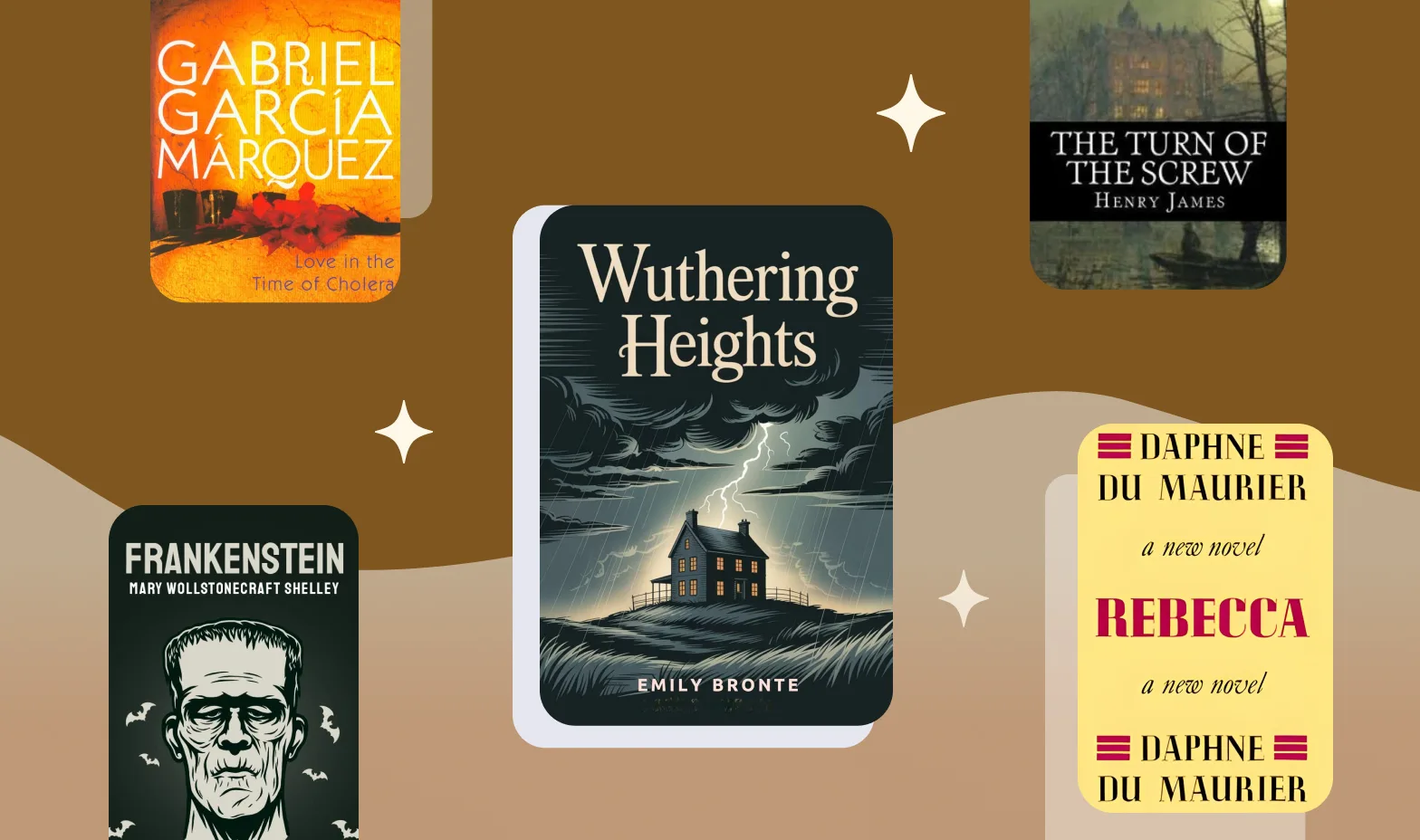
The Turn of the Screw by Henry James
Imagine yourself in the shoes of a young governess sent to the remote country manor of Bly to care for two children, Miles and Flora. Almost immediately, you see the apparitions of former servants who seem to have a sinister hold over the children. Do you really see it, or are you going crazy?

The Turn of the Screw
Why it’s similar to Wuthering Heights: The Turn of the Screw mirrors Brontë’s Gothic: spectral apparitions, a weather-beaten, isolated setting, and an unreliable narrator. It’s up to you whether to trust this narrator, but what goes without saying is this artwork’s Gothic vibe, along with bits of horror, psychology, and emotional devastation.
Interesting fact: The story was inspired by a ghost story told aloud by the Archbishop of Canterbury during a fireside gathering in 1895. Henry James himself was somewhat sardonic about the novella’s success, calling it a “shameless pot-boiler.” Anyway, he wrote it primarily because he needed money.
Jane Eyre by Charlotte Brontë
No wonder Jane Eyre is similar to Wuthering Heights, since it was written by Emily’s elder sister. It follows the orphaned Jane from her miserable childhood through her transformation into a governess at Thornfield Hall. But her life didn’t turn into a fairy tale romance. Mr. Rochester, master of Thornfield Hall, hides a terrible secret locked in the attic. What will happen when Jane uncovers it?
No book found (Book ID: 2665)
Sorry, we couldn't find the book you were looking for.
(only for Development purposes)Why it’s similar to Wuthering Heights: Jane Eyre shares the same Yorkshire Gothic atmosphere, secretive male lead with a dark past, and elemental passion. Both novels feature women of fierce interior life who navigate houses that hold unspeakable secrets.
Interesting spoiler: The “madwoman in the attic” was reportedly inspired by “Mad Mary,” a real woman confined in an attic room at Norton Conyers House some sixty years before the novel was written.
Love in the Time of Cholera by Gabriel García Márquez
Spanning over half a century, this novel is a dazzling and deeply uncomfortable exploration of love, obsession, aging, and mortality. Florentino Ariza and Fermina Daza fall passionately in love in their youth but are separated. Fermina marries a wealthy physician, while the heartbroken Florentino submerges himself in 622 sexual affairs across several decades. Will they be together at least at the end? Let us just say that this novel is quite similar to Wuthering Heights.
No book found (Book ID: 2666)
Sorry, we couldn't find the book you were looking for.
(only for Development purposes)Why it’s similar to Wuthering Heights: Like Heathcliff’s decades-long obsession with Cathy, Florentino’s consuming devotion warps his entire life. Both novels refuse to present love as redemptive and ask whether what we call love might actually be a form of madness, obsession, or beautiful self-destruction.
Interesting fact: Gabriel García Márquez reportedly said he wanted to write a novel in which the word “love” appeared as many times as possible, to restore it to something serious and true. And it does appear approximately 256 times.
Rebecca by Daphne du Maurier
“Last night I dreamt I went to Manderley again.” This line opens Rebecca, a novel about a young, unnamed woman who marries the wealthy widower Maxim de Winter. She arrives at his magnificent estate only to find herself living in the shadow of his dead first wife, Rebecca. What actually happened to that woman, and won’t knowing it destroy the fragile present?

Rebecca
Why it’s similar to Wuthering Heights: Rebecca has a lot in common with Wuthering Heights: a labyrinthine mansion, a brooding husband with dark secrets buried in his past, Gothic architecture, and an obsessive emotional register.
Interesting fact: Daphne du Maurier drew directly from her own life: she was tormented by jealousy toward her husband’s glamorous former fiancée, and poured that emotion into every page.
Frankenstein by Mary Shelley
Widely considered the first science fiction novel, Frankenstein tells the tragedy of Victor Frankenstein. He is a brilliant yet reckless scientist who dares to play God by reanimating a corpse. Will that creature be his demise? Or is it possible for the monster to experience love? Who will survive: the creator or his creation?

Frankenstein
Why it’s similar to Wuthering Heights: Mary Shelley’s novel is as Gothic as Brontë’s work, saturated in madness, vengeance, and death. It has a “Chinese box” narrative structure. It means that stories are nested within stories and told through multiple narrators of questionable reliability. Frankenstein is also about the monstrous consequences of all-consuming passion.
Interesting fact: Mary Shelley was just eighteen years old when she began writing the story. The novel grew from a ghost story competition between Shelley, her husband Percy, Lord Byron, and John Polidori.
Far from the Madding Crowd by Thomas Hardy
At the center of this novel is Bathsheba Everdene, who inherits a farm and gets the attention of three very different men. One is the steady, loyal shepherd Gabriel Oak. Second is the dashing and reckless Sergeant Troy. And the last is the obsessive, unstable Farmer Boldwood. Such a Darwinian competition of the heart rarely ends in “happily ever after,” but is this story any different?
No book found (Book ID: 2667)
Sorry, we couldn't find the book you were looking for.
(only for Development purposes)Why it’s similar to Wuthering Heights: Like Brontë’s novel, Far from the Madding Crowd’s setting is the English landscape. Thomas Hardy’s characters share Wuthering Heights’s unflinching willingness to follow passion to its most destructive ends, refusing any neat resolution.
Interesting fact: Bathsheba’s surname, Everdene, directly inspired Suzanne Collins when naming Katniss Everdeen in The Hunger Games.
The Impossible Us by Sarah Lotz
This “speculative love story” is the youngest of all works on this list, but it has the unforgettable charm of Wuthering Heights. Two strangers discover, through a series of accidental emails, that they appear to be living in parallel universes. What begins as an improbable correspondence grows into something far deeper and far more painful. Will this love story never exist in one dimension?
No book found (Book ID: 2668)
Sorry, we couldn't find the book you were looking for.
(only for Development purposes)Why it’s similar to Wuthering Heights: At its core, Wuthering Heights is about two people separated by forces that neither can overcome. The Impossible Us transports that same ache into a contemporary frame. The lovers here are separated not by Victorian society but by the very fabric of reality itself.
Interesting fact: Sarah Lotz wrote it during the UK’s first pandemic lockdown in her writing shed. This fact lends the themes of separation and longing a very particular biographical resonance.
Zofloya, or, The Moor by Charlotte Dacre
What happens if a selfish and passionate heroine, Victoria, partners with a mysterious servant, Zofloya? They dive into an intense spree of murders, seductions, and Faustian bargains. Morality? Forget about it, especially when you find out who Zofloya actually is.
No book found (Book ID: 2669)
Sorry, we couldn't find the book you were looking for.
(only for Development purposes)Why it’s similar to Wuthering Heights: The novel refuses to punish its transgressive protagonist merely for moral propriety’s sake. It also asks how far corrupted love and ambition can carry a person before they become unrecognizable to themselves.
Interesting fact: Charlotte Dacre published under the pseudonym “Rosa Matilda,” borrowed from a demon lover in Matthew Lewis’s notorious Gothic novel The Monk. It was a signal of exactly how scandalous she intended to be, especially in the explicit exploration of female sexual subjectivity.
The Thorn Birds by Colleen McCullough
Let us introduce yet another story about impossible love. Father Ralph de Bricassart, a Catholic priest whose ambition within the Church wars perpetually with his feelings for the girl Meggie, whom he has watched grow into a woman. Their love is forbidden by God, by vow, and by every social structure that contains them. Will this love burn them from within, or will they find escape in God’s embrace?
No book found (Book ID: 2670)
Sorry, we couldn't find the book you were looking for.
(only for Development purposes)Why it’s similar to Wuthering Heights: Like Heathcliff and Cathy, Ralph and Meggie are bound by a love that cannot be properly lived. Both novels treat decades of time as the true measure of romantic tragedy — the heartbreak is slow, accumulated, and total.
Interesting spoiler: In one of the novel’s scenes, Meggie experiences her first menstruation without understanding what is happening to her, and it is Father Ralph who must gently explain it to her.
Tess of the D’Urbervilles by Thomas Hardy
Originally subtitled “A Pure Woman,” this depicts the tragic life of Tess d’Urberville from the age of sixteen to twenty-one. Tess survives a lot: her rape by the predatory Alec d’Urberville; her doomed marriage to Angel Clare, who abandons her on their wedding night; and her slow, inevitable destruction by a society. Is she the one at fault for being a woman in an unjust world?
No book found (Book ID: 2671)
Sorry, we couldn't find the book you were looking for.
(only for Development purposes)Why it’s similar to Wuthering Heights: Both novels feature protagonists whose lives are governed, almost mystically, by landscape. Both grapple with claustrophobic female suffering and the way passion is ultimately crushed by the social and natural forces.
Interesting fact: Thomas Hardy’s publisher first refused to print the novel, so he had to tone down parts of it for its serialized version.
Love isn’t a safe haven
What unites all ten of these books with Emily Brontë’s Wuthering Heights is a refusal to make love safe. Love is weather, madness, and more often than not, a total wreck. For characters of these books, to love means to risk everything: status, family ties, money, and a comfortable life. And you can spiral into their passion, their grief, and their decay.