George R.R. Martin has done something that very few writers in any genre have managed: he has made fantasy feel genuinely dangerous. In most epic fantasy, the heroes survive because the story needs them to. In Martin’s A Song of Ice and Fire, nobody is safe: major characters die without warning. The books below will remind you of Martin’s style as well as bring in something new to your reading taste.
The Lord of the Rings by J.R.R. Tolkien
No list of books for George R.R. Martin fans is complete without the work that Martin spent his career responding to, subverting, and arguing with. The Lord of the Rings set the benchmark for high fantasy and established almost every major trope that subsequent writers in the genre have either used or pushed against.
Martin is in the “pushed against” camp. Tolkien’s world has a clear line between good and evil: the Fellowship of the Ring stands against Mordor. Martin dismantled it in Westeros, where there is no pure evil and no uncomplicated heroism, only human beings making choices under pressure. Reading Tolkien after Martin, or Martin after Tolkien, makes both writers more interesting.

The Lord of the Rings
The Prince of Nothing by R. Scott Bakker
Beginning with The Darkness That Comes Before (2003) and continuing through The Warrior Prophet and The Thousandfold Thought, this is epic fantasy for readers who found even Martin’s darkness not quite unflinching enough.

The Darkness That Comes Before
Set centuries after a mythical First Apocalypse, the series chronicles a religious holy war across a vast, philosophically dense secondary world. The characters’ motivations are unclear, beliefs are often delusional, and actions produce consequences that the narrative refuses to soften or redeem. This series is morally complex and dark, since it discusses the questions of free will, manipulation, religious fanaticism, and the nature of power.
The Name of the Wind by Patrick Rothfuss
Patrick Rothfuss’s The Name of the Wind occupies a specific and valuable position in the epic fantasy landscape. It does so by bridging the classical coming-of-age quest tradition and the modern, morally serious epic that George R.R. Martin's books represent. Rothfuss is writing closer to the bardic tradition, fitting for a story about a legendary figure narrating his own history.

The Name of the Wind
The novel follows Kvothe, who now lives in obscurity as an innkeeper. As he narrates his extraordinary life, we learn about his childhood with a traveling troupe of performers, his years surviving as a street child, his studies at a university of magic, and how he becomes a legendary figure. If you loved Martin’s character development, Rothfuss delivers it in abundance.
Masters of Rome by Gordon Doherty and Simon Turney

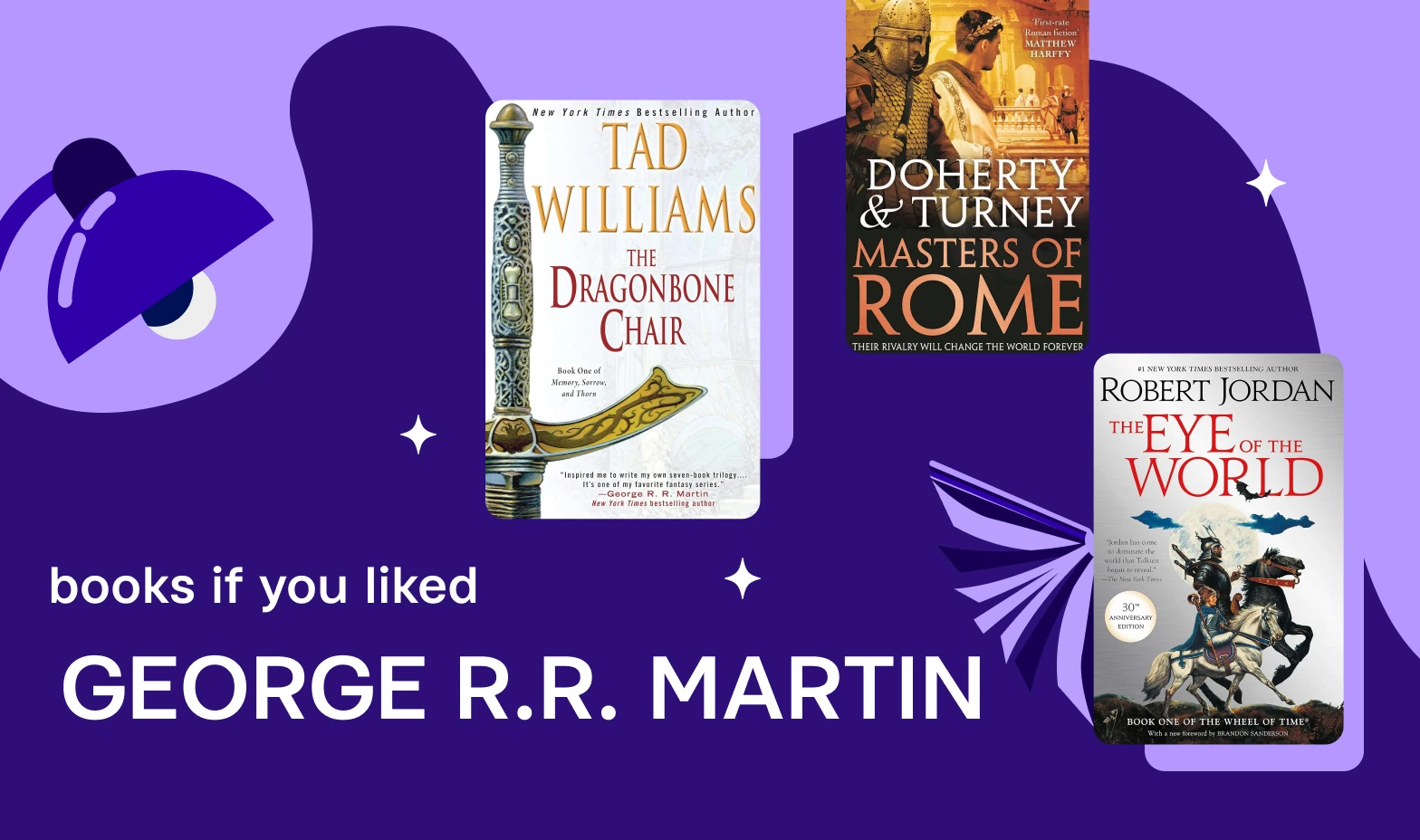
Masters of Rome
For readers who love George R.R. Martin for the political complexity and moral ambiguity, Masters of Rome is a perfect pick.
Here, you won’t encounter a single dragon or a White Walker (a member of the Others). Set in the Roman Empire around 308 AD, the story chronicles the escalating rivalry between Constantine and Maxentius. They used to be friends, but that friendship unravels as both fight to control the imperial throne. Palace manipulations, shifting religious dynamics, and brutal military campaigns against barbarian tribes make this novel particularly compelling. Perhaps the most interesting thing about it is its structure. Simon Turney, one of the authors, writes from Maxentius’s perspective, and Gordon Doherty, the other, writes from Constantine’s.
The Wheel of Time by Robert Jordan
Robert Jordan’s The Wheel of Time, beginning with The Eye of the World, is the other great multi-volume epic that George R.R. Martin fans come round to reading. It’s similar to Martin’s work, with its extraordinary scale, intricate political factions, and willingness to build a world so complex it rewards years of attention.

The Eye of the World
The series follows Rand, Mat, and Perrin, three friends from the rural village of Two Rivers. They are pulled into a global conflict that reveals Rand to be the reincarnation of a legendary figure whose destiny is to save or destroy the world. Reading this series, with thirteen main volumes and a prequel, will get you immersed in a world with its own long history and logic.
The Accursed Kings by Maurice Druon
George R.R. Martin calls The Accursed Kings — Les Rois Maudits in the original French — one of his primary real-history inspirations for A Song of Ice and Fire, describing it as “the original game of thrones.”

The Iron King
The series begins in 1314 with King Philip IV of France ordering the destruction of the Knights Templar and burning their last Grand Master, Jacques de Molay. As he dies, de Molay lays a curse upon everybody guilty of his death. What follows is a dynastic catastrophe: poisonings, public executions, royal infidelities, court rivalries, and a chain of succession crises. If you have ever wondered where the Red Wedding came from, this is the answer.
The Dragonbone Chair by Tad Williams

The Dragonbone Chair
The Dragonbone Chair is perhaps the most direct structural bridge between traditional high fantasy and the modern grim political epic that George R.R. Martin books represent. You can trace their connection in details like Hayholt, the great castle at the center of Williams’s story, and Winterfell; the Sithi and their ancient enemies, the Norns and the Others.
The novel follows Simon, whose comfortable life is shattered when the High King Prester John dies, and civil war breaks out between his sons. Meanwhile, Ineluki the Storm King — an undead ruler of the elf-like Sithi — makes a dark pact to reclaim the land from humanity. Simon’s quest is about to begin.
We read fantasy to find the colors again, I think. To taste strong spices and hear the songs the sirens sang.
— George R.R. Martin
There is a great deal of excellent reading on this list. None of it will replace what Martin does — but all of it will keep your imagination fully engaged until the next volume finally arrives.