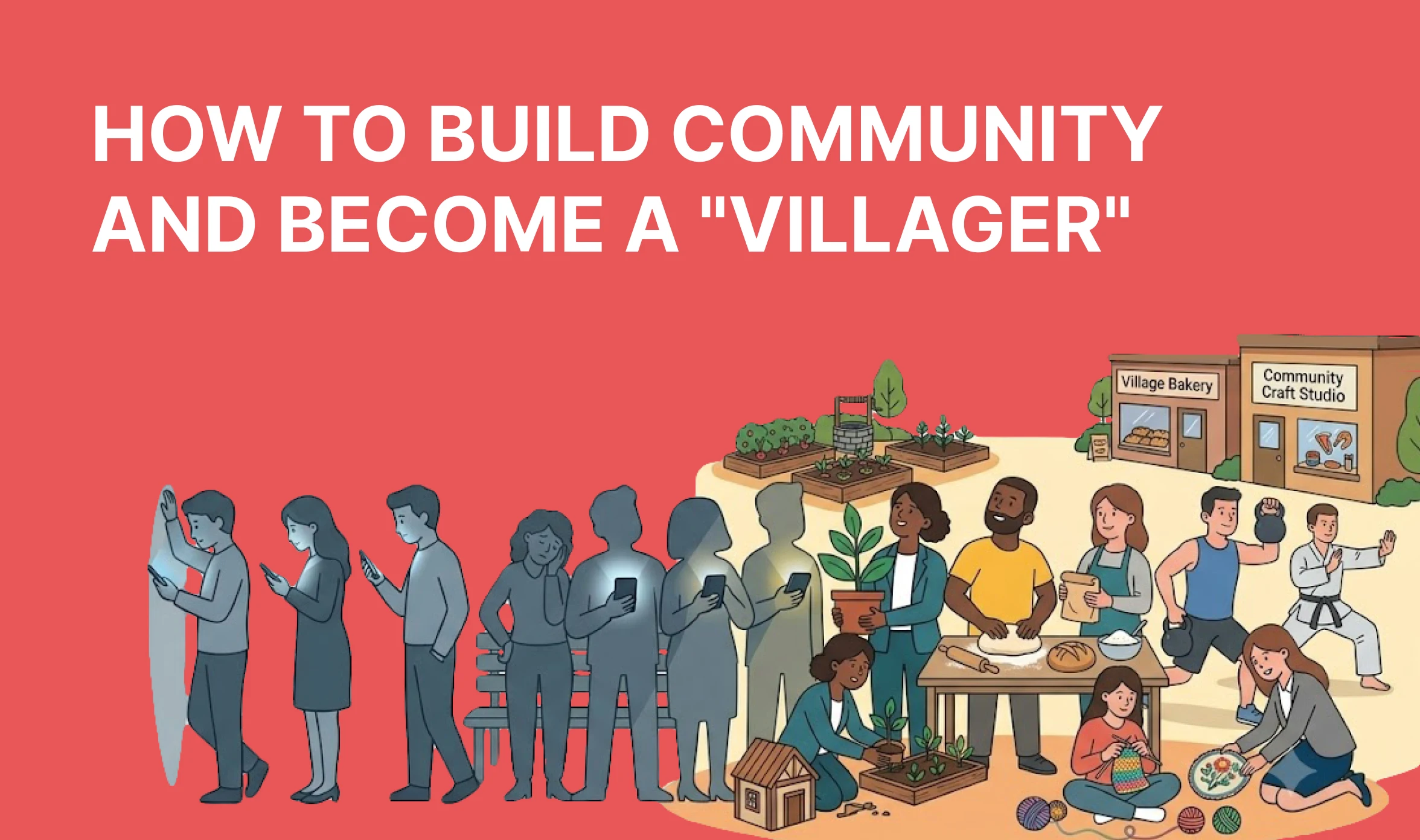
Lately, we’ve gotten remarkably good at being alone together. Seemingly connected to everyone online, we’re embedded in no one’s daily life and suffer from the loneliness epidemic.
Here is the alternative that everyone keeps talking about: building a “village,” a community in your life. But this perspective also requires us to change how we perceive communication. The vitality of a village depends on a shift from being a spectator to an active participant, a “villager” who shows up.
Loneliness is harmful to us, even physically
In his book Together, former U.S. Surgeon General Vivek Murthy makes a case that loneliness is actually a biological alarm system. Humans evolved a state of hypervigilance to protect against the dangers of isolation. When loneliness sets in, the body responds as if it’s under attack, so the stress hormones spike and blood pressure climbs.

Murthy identifies three different kinds of loneliness. There’s intimate loneliness, the ache for one deeply trusted person. There’s relational loneliness, the lack of a wider circle of friends. And there’s collective loneliness — the absence of a community of people who share your interests and goals. That third kind is exactly what “becoming a villager” is meant to solve. You can have a partner and a few close friends and still feel unmoored if you don’t belong to something larger than your immediate relationships.
Investing in social capital
Collective loneliness isn’t really a new problem. Sociologist Robert Putnam documented this decades-long trend in his work about building community, Bowling Alone. Between the 1970s and the late 1990s, Americans entertained friends at home roughly 45 percent less often, picnics dropped by nearly 60 percent, and family dinners eaten together fell by a third.
Putnam’s central argument is built around the idea of “social capital,” which is the productive value found in social networks. To build a healthy community, you must balance two types of connections:
- bonding social capital (supportive, inward-looking networks with people like yourself);
- bridging social capital (outward-looking networks that connect you to diverse groups).

Bowling Alone
How do you build your social capital? First and foremost, reconsider what counts as an interaction with someone. We need to recommit to the repeated and low-stakes social contact that builds trust over time. Think of the same faces at the same bowling league or the same friends at the same Sunday dinner. We can build community one shared evening at a time, accumulating like savings.
What one of the happiest nations can teach you
Denmark’s culture is designed to foster togetherness, which is why it routinely ranks among the happiest countries. A central pillar of this lifestyle is hygge, the art of creating cozy, comfortable moments of togetherness that provide a sanctuary from the outside world. Additionally, Danes place a high value on arbejdsglaede, or work-happiness, which stresses a healthy work-life balance that gives people the energy to participate in communal activities.
Many lonely people wonder how to meet new people. A large part of Danish life takes place in clubs and associations. Hobbies are treated as a way of life, with nine out of ten Danes belonging to organized clubs. Every person needs these “third places,” separate from work or home. Inside these clubs, status outside the door doesn’t matter, so people are simply bonding. A practical tip for any aspiring villager is to join at least one weekly social activity to discover new interests and expand your circle.

The seven principles of belonging
In The Art of Community, author Charles Vogl distills the architecture of belonging into seven principles. You might be surprised, but these show up whether you’re looking at a synagogue, a CrossFit gym, or a group of neighbors who’ve decided to start having dinner together once a month.
- Boundary. Every real community has some marker of who’s in and who’s out. A boundary basically tells people, “this space means something, and we’ll protect what makes it special.”
- Initiation. Vogl argues that strong communities create an intentional passage from outsider to insider, so new members feel seen rather than just tolerated.
- Rituals. Repeated and meaningful actions can turn abstract values into valuable experiences.
- Temple. Every community needs a place it returns to, whether that’s a literal room, a porch, or a recurring online space.
- Stories. Communities remember themselves through stories. These are how new members learn, often without being told outright, what it means to be “one of us.”
- Symbols. A shared phrase, object, or gesture becomes powerful only once it’s been earned through real participation.
- Inner rings. A progression of belonging that invites members into deeper levels of responsibility and care.
How to actually connect with other villagers
In adulthood, friendships and community do not happen by magic, but require intentional initiative. Marisa G. Franco’s book Platonic is a great resource for learning about friendship. First of all, when reaching out, assume that people like you, as this belief makes you act more open and confident. The research actually shows that people generally like us more than we expect, and they’re often just waiting for someone else to make the first move.

Secondly, friendship grows through something called propinquity. It is the mathematical principle that we bond with those we see regularly in shared spaces. You don’t have to become more interesting or more likable before you can start making friends. What you mostly need is to show up in the same place again and again (for instance, a yoga class or a book club).
Additionally, Franco argues that genuine intimacy requires real vulnerability. But it’s very important to distinguish this from what Franco calls “packaged vulnerability.” This fake vulnerability means sharing something personal without any actual emotional exposure. However, the version that builds trust is the one where you let someone see what you’re actually feeling.
Good villagers show up for each other
People tend to skip this last piece of advice because it’s the least convenient: the village runs on favors. Generalized reciprocity is the practice of doing something for someone now, without expecting anything specific in return. For example, raking your neighbor’s leaves before they blow onto your yard or showing up to a funeral you’d rather not attend. You’re investing in the kind of community where this is simply what people do for each other.
There is so much written and said on how to be a better friend. We’ve collected the best 15 books on friendship so that you can learn and get inspired. This list contains both pieces of advice and personal stories.
It takes a village, as people say! The “villagers” among us aren’t necessarily more extroverted or more naturally gifted at relationships. These are the ones who decided that collective loneliness is a problem worth solving on purpose. If this is something you aspire to, now you have a guide for action. Remember: sometimes all it takes is one dinner, one club, one hello, or one smile to build the thing you were missing.