Why survival literature grips us
Today, we live in an era called the Anthropocene, and it’s very different from our ancestors’ lives. For them, living was survival, be it foraging for food, building shelters against the cold, or assessing hazards in unfamiliar terrain. You might say that fortunately the world is less dangerous today than it used to be. But is it actually? People across the globe are suffering from wars or their consequences, left with no place to live and no food to eat. It’s similar to the moments of stress, danger, and uncertainty people before us had to endure.
When we read about a character stranded in the wilderness, dehydrated and injured and exhausted, trying to start a fire in the rain, something in us responds to that. We ask ourselves, instinctively: What would I do? Could I tough it out? Another reason for reading survival books could be our subconscious desire to strip away modern noise. Just us and water, warmth, food, shelter, calm under pressure.
As a Ukrainian, I read this book mainly for the first reason, and partly out of fear of what could come next. So, here is my honest review.
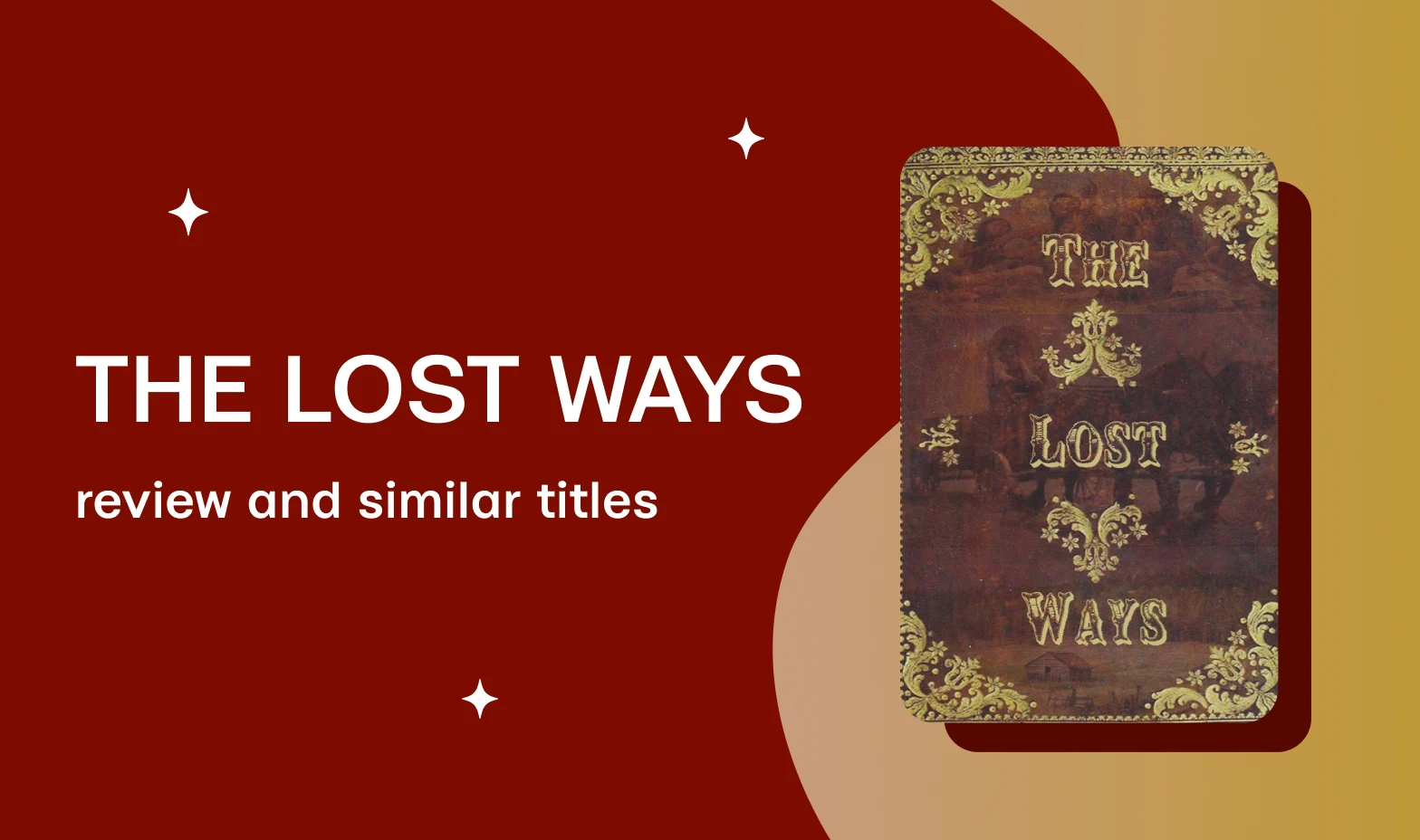
The Lost Ways: review
Although I decided to read it as a way to find some advice in case of an emergency, I found much more. One claim from this book that I completely agree with is that we depend on global supply chains, functioning power grids, stable financial systems, and the continuous availability of goods we have never learned to produce ourselves. I personally know individuals who can’t cook a simple dish without googling how to make it. And what if something bad happened and you had no Wi-Fi or mobile data, no delivery or pre-cooked meals?
The book doesn’t just teach you to survive; it makes you rethink the way you live. Even if you’re not in danger right now and don’t need to start a fire without matches or cook food with herbs out there, The Lost Ways is still worth reading. It’s a story that unveils 19th-century pioneer survival secrets and, at the same time, tells you some history.
Every survival skill is explained with practical steps, the ingredients or tools needed, and detailed descriptions of the conditions you need to meet. The beginning brings back the memories of listening to my grandma talk about WW2 and how they survived back then. The Lost Ways is like footnotes that we never read in our history books at school. It shows a life where getting a meal was a conquest, not just the numbers of people who died from famine.
Humans need to connect again—connect to each other and connect to our world. We need to learn the skills of our grandparents, skills that allowed them and their children to survive wars and famines.
— Claude Davis, The Lost Ways
One disadvantage I can point out is the amount of information. Like when you start reading about essential cooking skills, and it’s so fascinating at the beginning, but then you end up with recipe after recipe, endless lists of ingredients and cooking instructions. It’s not necessarily a bad thing; I just firstly chose the recipes I was interested in and then skimmed the rest.
The Lost Ways includes once-common knowledge, like food preservation, off-grid engineering, herbal medicine, fire-making, and navigation. Viewing it as a modern survival kit is perhaps the best way to approach it. Going to the mountains? Open the part with different navigation skills and learn from it. Don’t have access to healthcare? Check out if some herbal medicine could help.
One surprisingly simple skill from the book is making the self-feeding fire. Basically, logs are stacked on opposing sloped ramps so that as the bottom logs burn, fresh logs roll automatically into the embers, producing eight or more continuous hours of heat without anyone waking to stoke the fire. A great way to use gravity to your benefit!
This book is my honest recommendation as a reader to those who feel in danger living in the crumbling castle that is our planet and to those who want to learn something interesting and authentic. It might also be useful for people who enjoy hiking in the mountains or camping in the forest.

The Lost Ways
Into the Wild by Jon Krakauer

Into the Wild
If The Lost Ways gives you the theory of self-reliance and wilderness survival, Into the Wild gives you the most devastating real-world test of what happens when idealism meets the unforgiving requirements of actually staying alive.
Christopher McCandless was a top college graduate with a $24,000 savings account and a bright future ahead of him. He donated the money to Oxfam, abandoned his car and most of his possessions, and disappeared into the American wilderness. Guided by the transcendentalist philosophy of Emerson and Thoreau, McCandless wanted to survive in the wilderness on his own terms. His journey is the answer to the question, “What are we made of without the comfort of modern resources?”
Wild by Cheryl Strayed

Cheryl Strayed’s book isn’t meant to be the best survival guide to the Pacific Crest Trail. It’s about saving yourself. At twenty-six, Strayed was devastated by her mother’s death from cancer, the collapse of her marriage, and a heroin addiction that had left her barely able to scrape by. With no backpacking experience and a pack so heavy she nicknamed it “Monster,” she decided to hike over 1,100 miles of the PCT alone. This is a story of human endurance, and not a romantic one — it’s full of physical pain, genuine despair, and survival that simultaneously hurts and heals.
Into Thin Air by Jon Krakauer

Into Thin Air
In May 1996, Jon Krakauer was on Mount Everest reporting for Outside magazine when one of the deadliest storms in the mountain’s history trapped multiple climbing expeditions near the summit. Eight people died. Krakauer, who barely survived himself, wrote Into Thin Air as a firsthand account of what happened and why. Survival isn’t only about knowing how to catch a fish or keep warm in the rain; our judgment also matters. This book shows the pitfalls of human judgment in extreme conditions. Sometimes, you believe you’re completely rational but can’t see your mistake in the moment, and on Mount Everest, it could become a matter of life and death.
Wilderness Survival by Mark Elbroch and Michael Pewtherer
My final recommendation is a hands-on field manual — the closest thing on this list to The Lost Ways. The book is organized around five core ideas: Attitude, Shelter, Water, Fire, and Food. It’s a perfect "how to survive in the wilderness" guide for beginners. Each section provides detailed, practical instruction on survival techniques, such as building heat-trapping debris huts, purifying water by stone-boiling, and hunting with rabbit sticks. The authors describe how wild living quiets modern mental chatter, sharpens dormant animal instincts, and restores a sense of belonging in the natural ecosystem.
We be of one blood, ye and I.
— Rudyard Kipling, The Jungle Books
Even if we rarely notice our instinct to survive, it still dwells deep inside. Finding food, building shelter, staying warm, assessing hazards, and keeping going when giving up would be easier — all these books take us back to our roots, however uncomfortable they are. They offer survival tips, but also change how we view our lives a little bit, and maybe after reading some of them, you’ll get closer to nature.