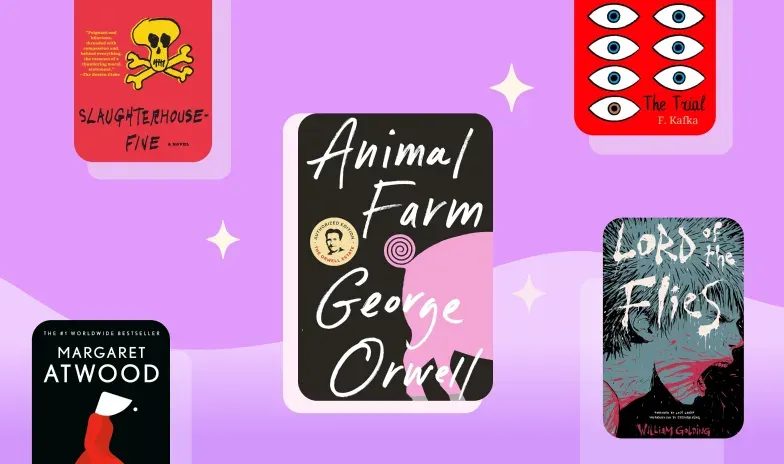
Margaret Atwood is a Canadian novelist, essayist, poet, and activist. Her best-known works include The Handmaid’s Tale, The Blind Assassin, Alias Grace, and the MaddAddam trilogy.

The Handmaid's Tale
If you’ve landed on this article, you already know what she writes about. We’ve prepared a short list of themes Atwood explores and nonfiction book summaries that can help you understand her works on a completely different level:
Feminism and women’s rights
You could read Invisible Women by Caroline Criado Perez to study how gender data gaps affect women in everyday life, or We Should All Be Feminists by Chimamanda Ngozi Adichie to learn more about gender inequality, stereotypes, and everyday sexism.
Politics and totalitarianism
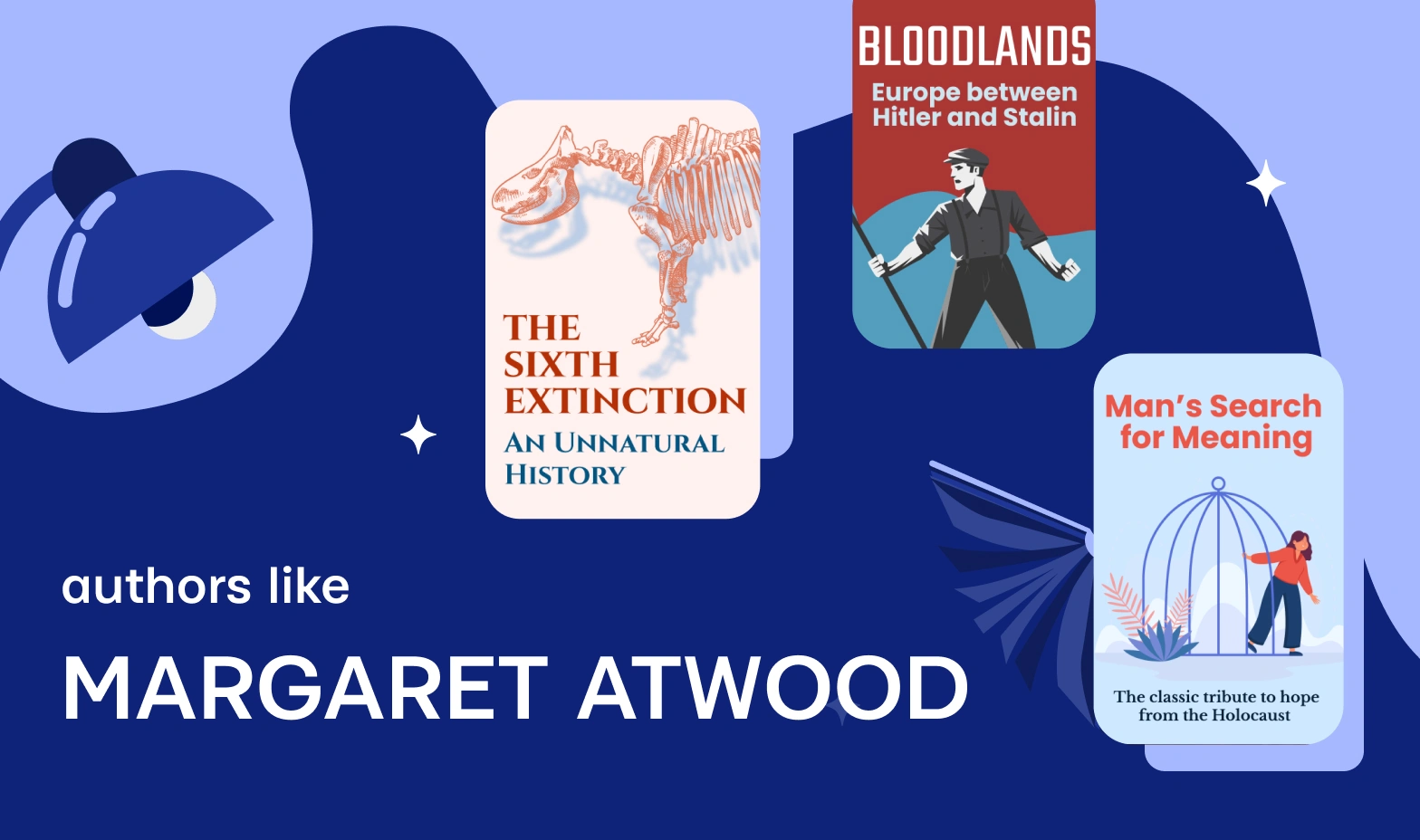
Take it from a real expert, Timothy Snyder, and his bestsellerBloodlands: Europe Between Hitler and Stalin .
Nature and ecology
Explore how human activity is contributing to the loss of species and major changes in ecosystems in The Sixth Extinction, which brought Elizabeth Kolbert the Pulitzer Prize for General Nonfiction.
Identity and survival
You can go for classics like Man’s Search for Meaning by Viktor E. Frankl, who writes about finding meaning and maintaining a sense of purpose in extreme circumstances. Or opt for a more scientific angle and read The Body Keeps the Score by Bessel van der Kolk, which examines how traumatic experiences can affect the body, memory, and behavior.
These nonfiction picks will definitely help you understand Atwood’s works better, as well as those of 5 authors similar to Margaret Atwood below.
Mary Gaitskill
“I have to have dinner with my mother at nine and after that I won’t be fit for human society.”
— Mary Gaitskill, Bad Behavior
This quote is from Mary Gaitskill’s notable work Bad Behavior. She focuses on broken, troubled characters and creates a tactile, visceral narrative atmosphere centered on complex human sexuality, power dynamics, and interior psychology.
Similar to Atwood, she is good at showing female interiority without fear. Both authors are interested in the way social and sexual pressure distorts female identity. Readers who love books like The Handmaid’s Tale for their psychological depth and moral complexity are also likely to enjoy Gaitskill's works.

Bad Behavior
Joyce Carol Oates
“I never change, I simply become more myself.”
― Joyce Carol Oates, Solstice
Joyce Carol Oates often appears on reader recommendation maps as a key author for fans of Margaret Atwood books, so we couldn’t leave her out of our list. Her notable works include We Were the Mulvaneys, The Falls, The Gravedigger’s Daughter, and Mudwoman. Readers and critics have described her as a “fearless writer,” pretty much like Atwood.
They both dig into the darkest places of the human soul. Another thing that connects these two authors is the blurry boundary between reality and imagination. If you are looking for dystopian authors like Margaret Atwood who bring the same literary seriousness to dark material, Oates is a great choice.

The Gravedigger’s Daughter
Kazuo Ishiguro
“After all, what can we ever gain in forever looking back and blaming ourselves if our lives have not turned out quite as we might have wished?”
― Kazuo Ishiguro, The Remains of the Day
Kazuo Ishiguro is one of the most celebrated novelists of the last four decades; his most popular works include Never Let Me Go and Klara and the Sun. Both Ishiguro and Atwood are speculative fiction authors who use imagined futures as a way to examine the questions about identity, memory, ethics, and what it means to be human. What’s interesting is that Atwood herself identified Never Let Me Go as one of her favorite books, describing it as “a brilliantly executed book by a master craftsman who has chosen a difficult subject: ourselves, seen through a glass, darkly.”

Never Let Me Go
Octavia E. Butler
“Repressive societies always seemed to understand the danger of ‘wrong’ ideas.”
― Octavia E. Butler, Kindred
Octavia E. Butler was an American science fiction author whose work has taken on an almost prophetic quality in the years since her death in 2006. Let us convince you to read one of her works, either Kindred or the Earthseed series, beginning with Parable of the Sower.
Octavia E. Butler is on this list of authors to read if you like Margaret Atwood because her novels also depict prophetic, speculative, and dystopian scenarios centered on strong women navigating totalitarian or collapsing social structures. Butler, as well as Atwood, asks uncomfortable questions about power, race, class, feminism, and social justice. She does so through characters who face violence head-on and try to survive.

Kindred
Ursula K. Le Guin
“You cannot buy the revolution. You cannot make the revolution. You can only be the revolution. It is in your spirit, or it is nowhere.”
― Ursula K. Le Guin, The Dispossessed: An Ambiguous Utopia
Ursula K. Le Guin was one of the defining literary voices of the twentieth century. Just like Atwood, she defied easy categorization and resisted the boundaries between genre and literary fiction. Among her works are The Left Hand of Darkness, The Dispossessed, and the Earthsea series.
In her books, Le Guin analyzed power systems, societal structures, gender identity, and sexuality. And she did it by removing them from their familiar context and examining them from the outside. Take her novel The Left Hand of Darkness. It imagines a planet whose inhabitants have no fixed biological sex. Isn’t it similar to what Atwood does with reproductive rights in The Handmaid’s Tale?

The Left Hand of Darkness
You’re not alone in trying to understand this complicated and messy world. Each of the authors above did the same in their books, each in their own way. And even though they do remind us of Atwood’s style, they are unique examinations of the problems and systems that have existed for a long time.