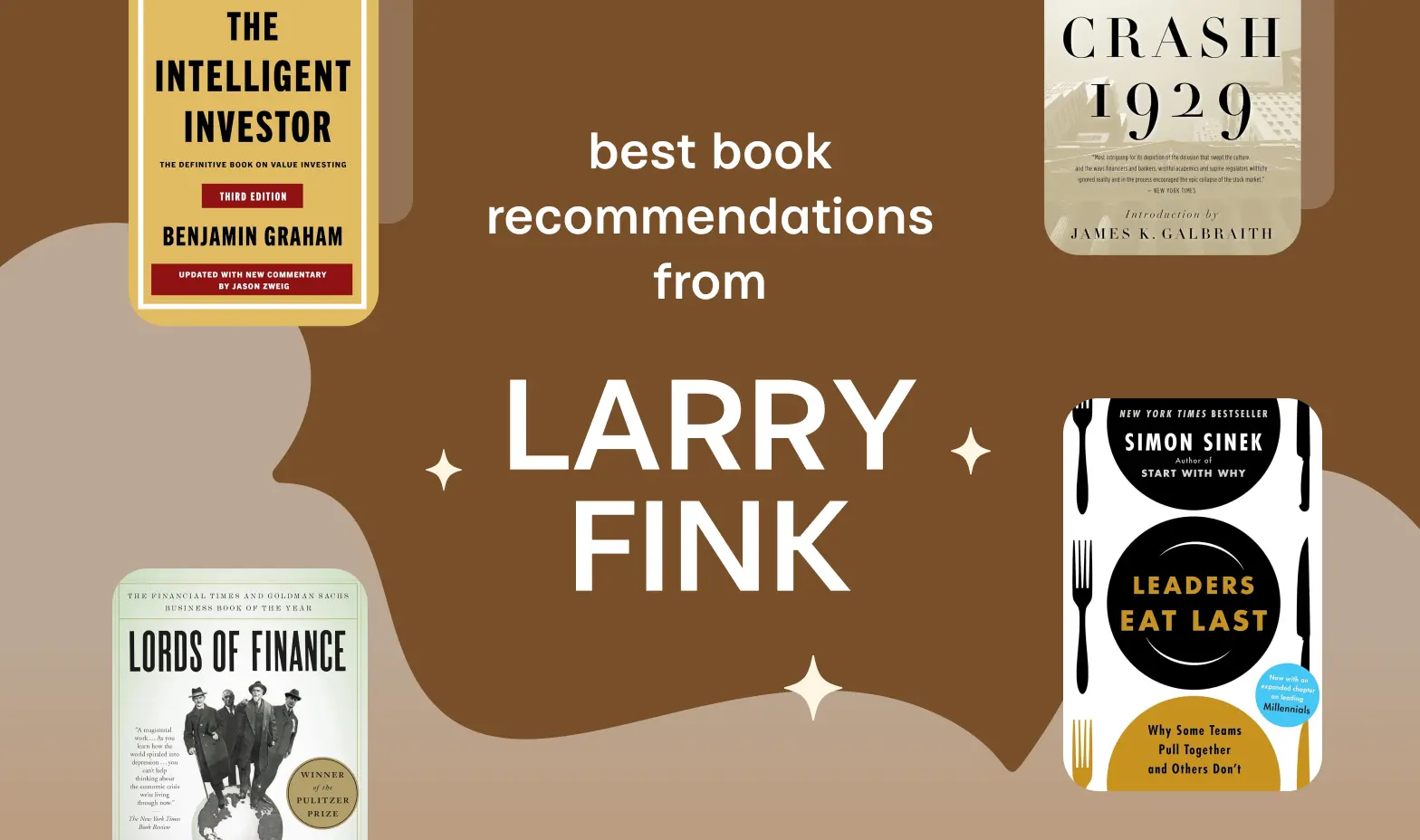
From a wide variety of books Fink recommends, we have selected for you the top 7 titles. The following books offer new perspectives and can teach you how to succeed amid constant change.
1. The Intelligent Investor by Benjamin Graham
This book is a true classic in the world of investments and is often cited as one of the most influential. Benjamin Graham, the mentor of the famous investor Warren Buffett, offers readers a deep understanding of the stoicism principles in finance. The Intelligent Investor helps investors focus on long-term strategies rather than immediate gains. Read more about it in The Intelligent Investor summary.

Graham pays special attention to the importance of analyzing and justifying each investment decision and distinguishes between two main investing styles: active and passive. He proves that in order to achieve a stable income, one should follow the principles of common sense and prudence.
2. Good to Great by Jim Collins
In his book, Jim Collins analyzes in detail why some companies succeed while others remain in the shadows. He conducts an in-depth study of 1,435 companies and selects those that have moved from “good” to “great”. The book provides inspiration and practical advice for executives seeking to succeed in a rapidly changing business environment. In the Good to Great book summary, you can find detailed instructions on how to do exactly that!

3. Lords of Finance by Liaquat Ahamed
Lords of Finance tells the story of four central bankers who became key figures during the Great Depression. Liaquat Ahamed examines how their decisions, particularly on monetary policy, affected the global economy and led to the 1929 crisis. The book highlights the importance of financial leadership and responsibility in times of economic turmoil.
Ahamed thoroughly explains the role of institutions and the people behind them in shaping financial markets and how their decisions influence future events.

Lords of Finance
4. The Big Short by Michael Lewis
One of Fink’s most frequently cited favorites, this book unpacks the events leading up to the 2008 financial crisis. It is written through the eyes of the small group of investors who saw it coming and bet against the housing market. For Fink, it’s a case study in the dangers of groupthink and short-term thinking in financial markets — the very forces BlackRock has positioned itself against by emphasizing risk transparency and long-term value creation.

The Big Short
5. The Great Crash of 1929 by John Kenneth Galbraith
This book is a classic for anyone interested in economic crises. John Kenneth Galbraith offers his view on the events of 1929, when the American stock market suffered a catastrophic collapse that led to the Great Depression. He analyzes the causes of the crash and shows how human emotions, such as greed and panic, can affect financial markets.
Galbraith also emphasizes that even the most developed economies are not immune to such events. At the same time, The Great Crash compares 1929 to other financial crises in history, making it clear how similar mistakes can be avoided in the future.

The Great Crash of 1929
6. The Lean Startup by Eric Ries
This book has become the basis for a new wave of entrepreneurs and startups. Eric Ries talks about the concept of “lean startup,” which is based on minimizing costs and maximizing the speed of testing and implementing ideas. Rees emphasizes continuous improvement and market testing of products before a large-scale launch.

Instead of traditional business plans, Rees offers an adaptive approach to startup development that significantly reduces risks.
7. Leaders Eat Last by Simon Sinek
In Leaders Eat Last, Simon Sinek explores the role of leadership in building cohesive teams. He examines how leaders can create a safe environment in which people are willing to trust one another. Our summary of Leaders Eat Last will help you reach your leadership potential and realize it in all spheres of your life!

Sinek provides examples from various fields, from business to the military, where successful leadership also rests on mutual support and responsibility. He shows how true leaders put their teams’ interests first, thereby ensuring long-term success.
The books recommended by Larry Fink reveal many insights for those seeking to succeed in business, finance, and leadership. By investing time in these books, you get a chance to become a better investor as well as a leader who can influence the development of the modern business environment.