Cues
Brief Summary
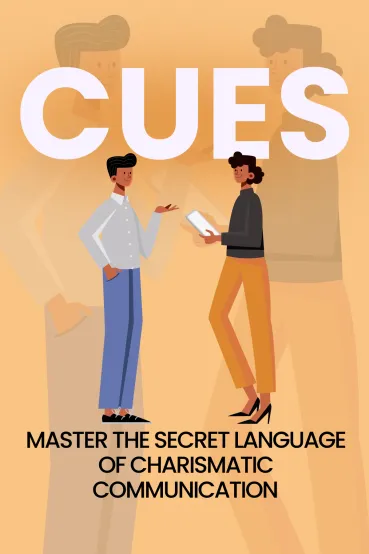
We’ve all admired those effortlessly captivating individuals who seem to grab attention wherever they go. What is it that sets them apart from the rest? It’s not just luck or charm but a mastery of nonverbal cues. In “Cues,” Vanessa Van Edwards, a leading expert in human behavior, explains how to master the secret language of charismatic communication.
Key points
Key idea 1 of 8
Charismatic people have a unique way of connecting with others, and much of this comes from the signals, or “cues,” they use in their communication. These cues form a hidden language, which silently influences how we perceive and interact with one another. Using the right cues can transform an ordinary conversation into something memorable. Wrong ones, however, can result in misunderstandings and missed opportunities. Cues can be categorized into several types, which we’ll explore in a second.
Each of the cues has a specific role in communicating with others. Firstly, humans use nonverbal cues. These include our body language, gestures, and facial expressions. All of them can convey our feelings and intentions without us even having to say a word. Secondly, there are vocal cues that determine how we speak. Cues such as our voice’s tone, speed, and volume can significantly impact how our words are perceived. Verbal cues, or the words we choose, convey meaning and intent in both spoken and written forms. Finally, there are imagery cues, such as the colors we wear or the items we surround ourselves with.
A study from Princeton University found that highly charismatic people display a mix of two key traits: warmth and competence. Warm people are frequently approachable, trustworthy, and compassionate. Additionally, their competence may be seen in their skills, knowledge, and capabilities. People who balance these traits tend to stand out positively. It might seem as if they were born charismatic.
Still, most of us struggle with finding this balance. For instance, people characterized by warmth prioritize being liked and trusted but might struggle to assert themselves. They are good at building relationships but might not always be taken seriously. An illustrative case is Steve Wozniak, whose warmth overshadowed his technical achievements compared to his more assertive partner, Steve Jobs.
On the other hand, individuals high in competence are respected and admired for their skills but can sometimes seem unapproachable. They may excel in their careers but find it hard to connect on a personal level. These people may encounter difficulties in collaborative settings. Figures like Mark Zuckerberg and Elon Musk exemplify this dynamic.
Do not worry if you find it hard to be charismatic. Charisma isn’t something you’re just born with. You can learn this trait by becoming observant and conscious of how you get perceived. And it doesn’t mean you have to pretend to be someone you’re not. Charisma comes in many forms, from the lively, outgoing type to the quieter and thoughtful kind.
You may also like these summaries