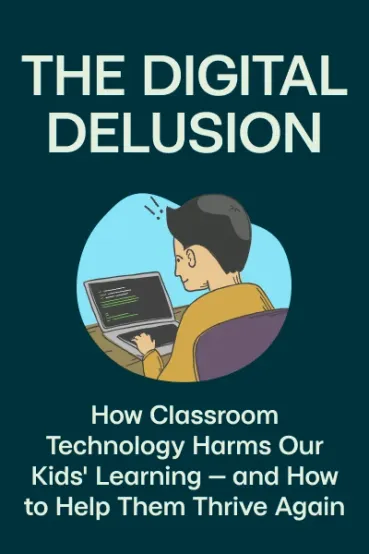
The Digital Delusion
Brief Summary
Technology was supposed to fix education. Billions of dollars, millions of devices, and two decades later, the evidence tells a very different story. Jared Cooney Horvath unveils the myths about EdTech and shows its influence as it is.
Key points
Key idea 1 of 6
Have you ever sat through a TED Talk where a convincing speaker declared that education is broken and technology is the cure? But is that actually true? Let’s go through five big assumptions the EdTech industry is built on.
The first myth is that education is broken. We hear it so often that we already take it for granted. But research shows that schools were performing well by nearly every international measure right up until the large-scale introduction of digital technology into classrooms. If anything, the arrival of screens correlates with the decline in student performance and mental health that we’re now so worried about.
The second myth is that multimedia makes learning better. Perhaps you’ve seen lessons online or in a classroom that use interactive animations and funny audio. These classes are certainly interesting, but are they instructive? Bells and whistles actually can draw attention away from the real information rather than toward it. So, when you or your kids are entertained while studying, it doesn’t necessarily mean you understand the subject deeply.
The third myth is that giving students free choice leads to better learning (the so-called “personalized learning”). A landmark 2006 study found the opposite. Students who engaged in laborious, if uncomfortable, revising learned far more than those who opted for simpler, more comfortable methods.
The fourth myth is that children learn best on their own. But here, people confuse two very different things. For example, toddlers do learn naturally and effortlessly — language, walking, social cues — because evolution built those skills in. But after about age five, learning becomes something different and requires expert guidance. Without a teacher, students in self-directed digital environments tend to flounder.
The fifth myth is that AI tutoring systems make students smarter. These systems are based on a model of “teaching machines” developed by the psychologist B.F. Skinner seventy years ago. Undoubtedly, they can be useful in narrow areas like basic arithmetic. But they lack the human ability to read a student’s confusion, respond to their frustration, and keep them motivated when the work gets hard. Together, the five myths mentioned above cause genuine harm to children’s development.
You may also like these summaries