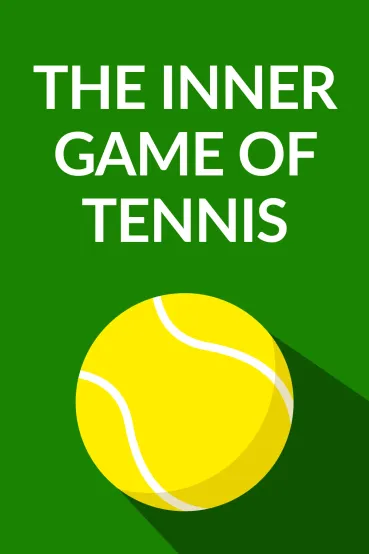
The Inner Game of Tennis
Brief Summary
Have you ever encountered mental obstacles or self-doubt when working toward a goal? “The Inner Game of Tennis” explains how mastering any skill or surmounting any obstacle in life requires overcoming internal distractions using tennis as an example. In his exploration of the role of the mind in athletic performance, Gallwey explains how to suppress the inner critic and let the body function as it should.
Key points
Key idea 1 of 6
In any endeavor, especially in sports, mental preparation is no less important than physical preparation. We may be well-trained and athletic enough to win, but something gets in the way. Nervousness, self-doubt, or lapses in concentration sneak up on us in the most stressful moments. Many athletes complain that they perform better in practice than in matches and struggle with tasks they typically excel at. Why does that happen?
Timothy Gallwey, the author and former tennis coach, states there are two games happening: the inner and the outer. The outer game happens against external opponents or challenges. This is what we typically consider a tennis match or some kind of ball game. On a deeper level, there’s the inner game that happens against the mental obstacles we create for ourselves. That’s where athletes struggle most.
Many tennis players obsess over perfecting technique and strategy for the outer game. They focus on the proper grip or footwork, ignoring what’s going on in their mind. Good technique is essential, but it’s only a part of the equation. Peak performance occurs when the mind is calm, when you’re playing “in the zone.” The goal of the inner game is to trust your body’s innate wisdom and get out of your own way.
This is where the concept of Two Selves comes into play. Gallwey began noticing how players talk to themselves on the court, saying things like, “Come on, keep your eyes on the ball.” The question was, who was the one giving the instructions and the one executing the action? He came up with the idea of Two Selves: the conscious and critical Self 1 and the unconscious, natural Self 2. In other words, Self 1 is the “teller,” while Self 2 is the “doer.”
The relationship between these two determines how we translate technical knowledge into practice. Self 1 often struggles to trust Self 2 to take action. This is when the player starts hearing critical thoughts and doubting themselves. Self 1 thinks it’s helping, but it’s interfering with Self 2’s ability to learn and perform automatically. So, in order to improve your performance, you need to find harmony between the Two Selves.
You may also like these summaries