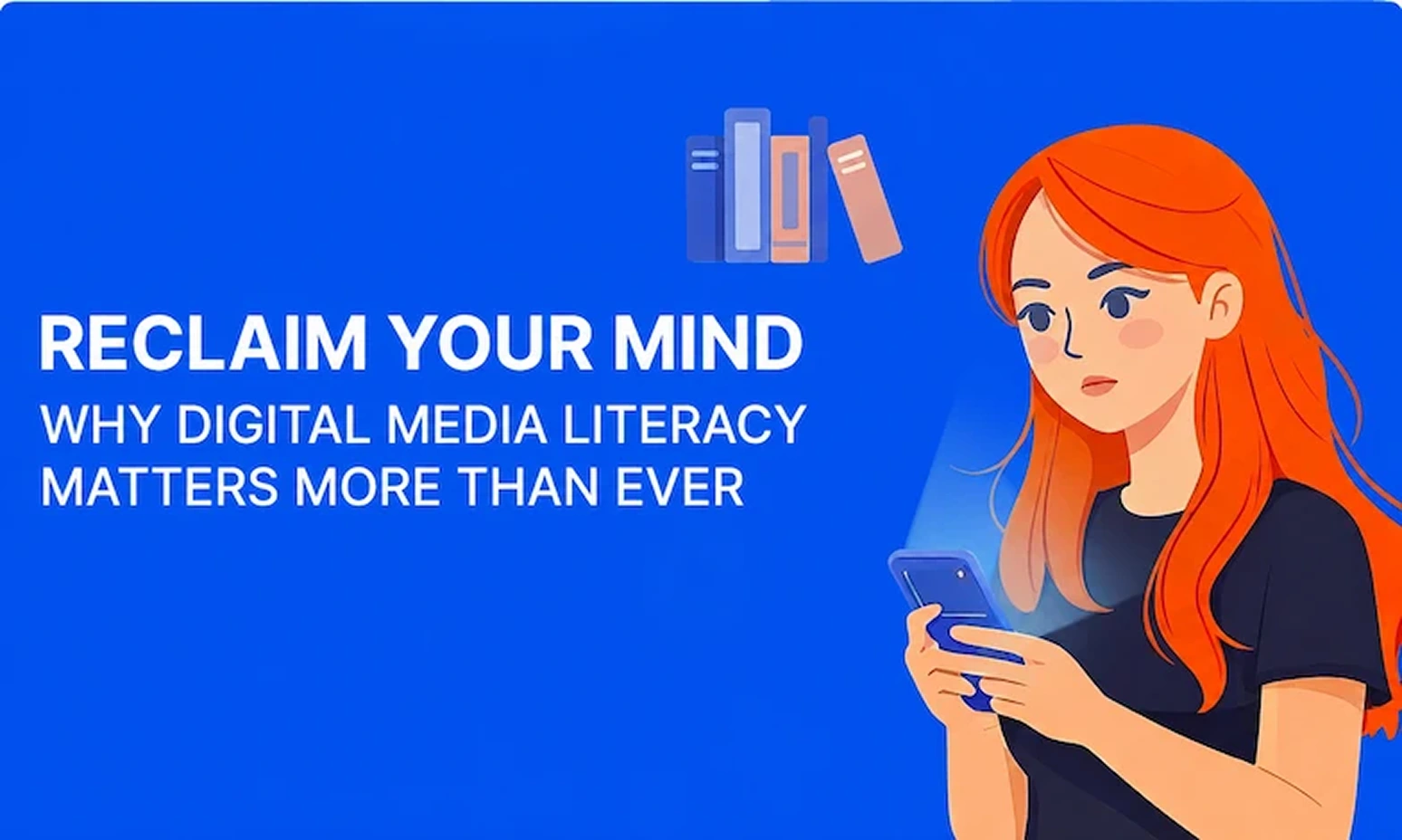
Ask yourself: do you tend to think critically or just agree with your feed? Every time we scroll, we form an opinion based on something we’ve read online. Hundreds of headlines and posts create an illusion that you’re staying informed. But because very few people are trained to spot deceptions in this flood of data, media illiteracy has become a widespread vulnerability.
The essence of the independent mind lies not in what it thinks, but in how it thinks.
— Christopher Hitchens, Letters to a Young Contrarian
The digital world is frequently filled with misinformation, which includes both unintentional false claims and deliberately misleading narratives. Virtually everyone is now targeted by fake news, ranging from political propaganda to sensationalist stories created simply to generate revenue. How can you stay vigilant in this information overload?
Understand how your brain reacts to information
Before blaming social media algorithms or shady journalists, it helps to understand that the problem starts from within. In Factfulness, professor Hans Rosling identifies cognitive instincts that cause virtually everyone to misread the state of the world. These biases are rooted in human evolution and do not reflect a person’s intelligence.
The negativity instinct makes us view the world as worse than it actually is. We’ve all fallen prey to it — just think of all the dramatic headlines and bad news that get clicks. Another cognitive bias, the fear instinct, compounds this further. That’s because we are prone to overestimating the prevalence of risks such as disasters or violence.
What can you do? Next time a headline makes you feel a surge of fear or outrage, pause. Ask yourself whether the material is feeding your negativity or fear instinct. Additionally, to learn more about cognitive instincts, see our summary of Factfulness.

Trust data — but question the way it is analyzed and presented
Seth Stephens-Davidowitz, a data scientist and the author of Everybody Lies, writes that big data can reveal truths if used well. Did you know that people frequently lie for about a third of the time? This is especially true when someone wants to make themselves look better. People do lie, yet traditional data collection methods are almost entirely blind to it.
This influences how we consume information. The polls that tell you what people believe about social issues are almost certainly skewed by what people are willing to admit publicly. Does it mean data is useless? No, but big data is only as trustworthy as the questions being asked of it and the person asking them.
When a headline tells you that research has found a link between two things, it’s worth pausing to ask: was this a genuine large-scale study, or did someone mine a dataset for something interesting? Who funded it? And does it reflect what people actually do, or what they say they do? To learn how to treat the data with proportional skepticism, read our summary of Everybody Lies.

The words you read are a form of influence
Digital media literacy requires paying attention to the language. Specific vocabulary can be used to subtly control human behavior, influencing our views and actions. This is the topic of the book Cultish by linguist Amanda Montell, who traces this from fitness brands to other social media communities.
Language has the power to create a new reality, and we see it everywhere, especially in political messaging and viral content. For instance, spiritual influencers may use social media propaganda to promise “supernatural abilities,” while dismissing any critical thinking as a sign of a “limited mind” (Read the summary of Cultish to discover more real-life stories and examples).

Try noticing when language is doing emotional work on you. Does a piece of content make you feel strongly included in a group or strongly opposed to them? Ask yourself whether you’re responding to evidence or to the emotional charge of the language itself. Learn to recognize when a group is using “bright mottos” designed to manipulate your emotions.
Information overload is part of the problem
Even if you’re skeptical of misleading data, there’s one more obstacle: too much information coming at you. When our minds are overwhelmed, we default to shortcuts, such as skimming headlines and mistaking them for full articles. Combine this with social media addiction, and you become constantly stimulated but rarely actually informed.

But don’t worry, it’s in your power to reclaim your mental space. If you realize that you’re much too tired of the flood of information, try a dopamine detox or digital detox. Deliberately step away from the overstimulating content loop. Challenging? For sure! But the results are worth the effort. And it doesn’t have to be dramatic. Even a single screen-free morning can give your mind the space to process the information better.
There are many other tools to help you stop being overwhelmed and become mindful and unbiased. If this is something you’d like to explore, here is our article on how to avoid information overload.
Ways to actually push back on bad information
Now think of a time you’ve noticed misinformation in a post or a video. What could you do to challenge incorrect information? The authors of Calling Bullshit, a book about skepticism in a data-driven world, suggest several strategies:
Reductio ad absurdum is the process of taking a claim to its logical limit and determining whether it still holds. For example, a 2004 article predicted that by 2156, women would outrun men. By pushing this logic further, the conclusion ignores the real biological and physical limitations of human speed, making it ludicrous.
Another method is looking for counterexamples. If someone says that B always comes after A, consider situations in which B occurs without A. This is frequently enough to swiftly undermine a feeble argument.
You can also try using analogies to reframe a misleading claim in a context where the flaw becomes obvious. When people question the value of a flu vaccine because it only reduces danger by a small percentage, you can use the analogy of a seatbelt. Just like a seatbelt, even if it doesn’t offer 100% protection, it still significantly reduces overall risk and saves lives.
Winning arguments feels good, but our goal here is to think critically and find the truth. Calling Bullshit is a valuable work on this topic, which we highly recommend reading.
Remember this: in our era, becoming mindful and unbiased in your consumption is life-saving. By taking these steps, you can learn to filter out the noise and avoid being “hooked” by extreme optimization. Staying true to your own values and opinions is becoming more difficult lately, but it is still possible.
Credentials:
- Image by kaboompics on Magnific
- Photo by Azwedo L.L.C. on Unsplash