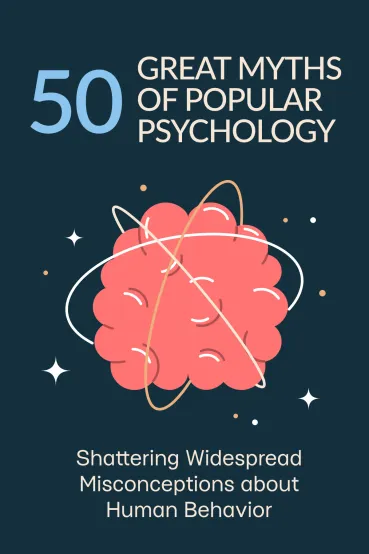
50 Great Myths of Popular Psychology
Brief Summary
Some things that you know about psychology are complete nonsense, and “50 Great Myths of Popular Psychology” can prove that. You will understand the science that debunks myths and uncover what drives human behavior. Authored by four psychologists, the book blends solid science with an effortless reading experience.
Key points
Key idea 1 of 8
You’d be surprised how easily a myth can become perceived as a fact. After all, popular myths often sound memorable and easy to believe, especially after being repeated so many times. We need to be careful about things that seem true, but for which we have no proof. Misconceptions can be harmful and even dangerous, mainly because they erode our critical thinking.
How do popular myths come to be? First of all, by word of mouth, the more we hear about something, the more we perceive it as common sense. Secondly, humans tend to seek quick fixes and easy solutions. But it’s helpful to remember that if something sounds too good to be true, it probably is. With this in mind, let’s dispel some myths of popular psychology.
“Did you know people use only 10% of their brain power?” claim many self-improvement books and motivational speakers. Did you also know that it’s not true? Clinical neurological evidence demonstrates that losing even a small fraction of the brain typically ends badly. This myth likely originated from a misunderstanding of early neuroscience research and was later popularized by Dale Carnegie. The idea became so pervasive because it sounds catchy and offers hope to tap into your brain power.
Another widespread myth is that some people are left-brained while others are right-brained. You’ll frequently hear that people can be divided into “creative” or “logical” types based on their dominant hemisphere. It’s true that these two hemispheres are responsible for different functions. However, they work together and share more similarities than we expect. So next time you come across experts who promise to help you develop a dominant hemisphere, ignore them.
If you’ve ever searched for the symbolic meaning of your dreams, you might be disappointed to learn that it’s also a myth. Dream dictionaries offer interpretations for your dreams, convincing you that you can unlock the secrets of your subconscious. Yet, most contemporary scientists reject this idea. Dreams are simply the brain’s attempt to create coherent stories from chaotic neural firing patterns during REM sleep.
The idea that hypnosis is a special kind of “trance” is one of the many common misconceptions about consciousness. Hypnotized people are often portrayed in the media as zombies, performing embarrassing actions against their will. Still, scientific testing reveals no unique physiological markers distinguishing hypnosis from normal waking consciousness.
You may also like these summaries