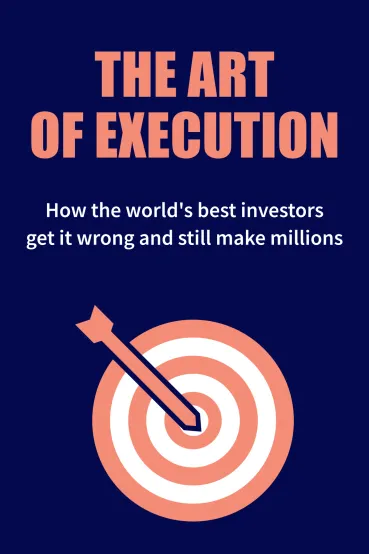
The Art of Execution
Brief Summary
“The Art of Execution” by Lee Freeman-Shor is your guide to the world of investing. Drawing from his experience as a fund manager, Freeman-Shor reveals how to get profits by developing strong execution habits. Discover why execution is the key to successful investing.
Key points
Key idea 1 of 6
Imagine a rabbit continuously digging itself into deep holes. The least successful investors are like this rabbit. Even with enough experience, they fail to adapt and dig themselves into a losing cause deeper and deeper. After all, they don’t recover their capital. What are the common flaws in their actions?
Would you hold onto shares for 23 months despite a 96% loss? Rabbits would. It mainly occurs because of the primacy effect, also known as the primacy fallacy. Simply put, it’s when your initial impression of something has too big an effect on you, and you refuse to accept new information. Instead, Rabbits make up positive stories to justify their losses. Such behavior is influenced by the Narrative Fallacy Framing Bias and may lead to financial losses. For example, one investor who had invested in Vyke Communications—a highly speculative stock—kept hoping it would succeed even after its value dropped by 99%. Eventually, the company was removed from the market and went bankrupt.
Besides, Rabbits are more afraid of being “wrong” than losing money. That’s why they often search for validation of their beliefs rather than ways to improve their accuracy as investors. Because of self-attribution bias, they blame bad luck or other external factors for their losses. Another phenomenon seen in Rabbits is the denomination effect, which leads to a low chance of quitting investing in large but losing stocks.
How can Rabbits understand that it’s time to stop investing in a certain company? First, create a clear plan with two options for dealing with investments: selling out or significantly increasing your stake. Ask yourself, “If I were starting fresh today, would I still buy this stock with what I know now?” Unless your answer is “yes,” it’s better to sell. The data showed that only 3% of bad investments later turned into good ones, meaning most investors failed to adjust. You should keep in mind that significant losses are often impossible to recover from, even if the stock price recovers later. So, protect your money and do not get stuck on your first idea. Good investing is about making the right moves, not just having the right opinion.
You may also like these summaries