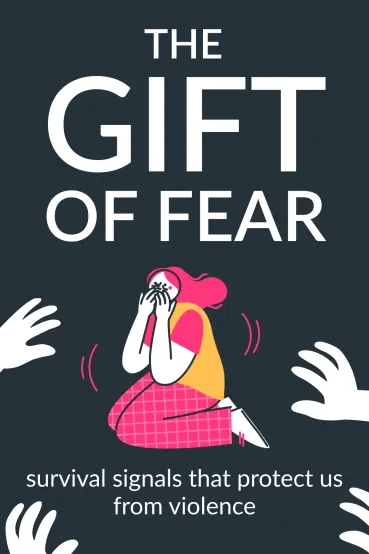
The Gift of Fear
Brief Summary
What’s the difference between true and unwarranted fear? Knowing the answer can help you trust your instincts and stay safe. “The Gift of Fear” by Gavin de Becker offers ways to identify the signs of danger and advises you on protecting yourself.
Key points
Key idea 1 of 6
Security expert Gavin de Becker specializes in predicting and preventing violence. He has spent decades advising law enforcement agencies, governments, and private individuals on how violence occurs and how we can prevent it. One of the main insights from his work was that our intuition is a natural and valuable signal that shouldn’t be dismissed.
Our “gut feeling” is not a vague hunch but the result of pattern recognition. Sometimes, this recognition can save lives. Case in point — Kelly’s story. When her grocery bag tore on the stairs, a friendly stranger appeared and offered help. Something felt off to Kelly immediately, but she pushed the feeling aside. Even though she refused at first, the stranger sweet-talked her into letting him into her apartment to carry the groceries in. Moments later, he raped and almost killed her.
But with the help of an intuitive signal, Kelly got out alive. When he said he was leaving and went to her kitchen “for a drink,” she noticed he’d closed her bedroom window. Why? She realized he wanted to muffle the sound. While he was looking for a weapon, Kelly quietly escaped.
When people talk about moments of harm afterward, they say, “I knew something was wrong, but couldn’t explain why.” For instance, think about a woman waiting for an elevator late at night. The doors open with a man inside, and something about him frightens the woman. Instead of trusting this survival signal, she tells herself not to be “rude” or “silly.” But which is sillier: waiting for the next elevator, or entering a soundproof steel box with a stranger you fear?
Sadly, people often disregard their inner warning signals when they can’t back them up with clear reasoning. Culture encourages us to give people the benefit of the doubt and to avoid appearing rude or judgmental. But does it mean politeness or rationalization are more important than our internal alarms? Still, when we feel real distress, this is not random. Such a feeling only surfaces when someone’s behavior or micro-signals hint at danger.
You may also like these summaries