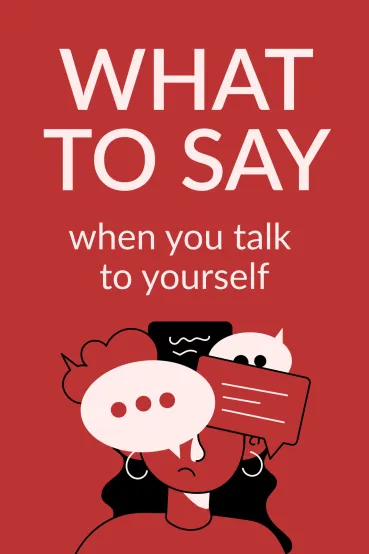
What to Say When You Talk to Yourself
Brief Summary
Do you still criticize yourself after any small mistake? “What to Say When You Talk to Yourself” will help you get rid of this bad habit. Get practical tools to reduce harmful negative self-talk and gain more confidence today.
Key points
Key idea 1 of 6
At some point, many of us have felt extremely self-conscious, as if we can’t do anything right. Sure, it’s essential to have a realistic view of your strengths and weaknesses, but most of us usually lean more to the negative side. Such harmful conditioning in our minds leads to thoughts and actions that hold us back. What if we could do something about that?
Dr. Shad Helmstetter argues: “You will become what you think about most.” You see, our perception of ourselves and the world lies in the programming our mind receives. More often than not, this programming is negative. For example, an average child hears “No” from parents or teachers about 148,000 times by age 18. Hearing what they “can’t” do often limits the children’s capability to recognize what they can do.
Leading behavioral researchers suggest that as much as 77% of our thoughts work against us. Consider the things that we frequently say to describe ourselves and our abilities (such as “I can’t remember names,” or “I’m not good with money”). Since it doesn’t distinguish between truth and fiction, our subconscious mind takes these statements as programming. This forms a powerful, invisible “wall” that hinders our potential.
Although our mental programming is largely shaped by parents and educators, we keep adding to it throughout adulthood. The culture that tells us we “should” follow some trends, the media that promotes negativity, and even our friends play a role. Everything we surround ourselves with creates certain patterns. But most of all, we do it ourselves, by repeating discouraging thoughts in our heads.
Negative programming should be erased or replaced; otherwise, it will permanently affect everything we do. Realize that your internal dialogue matters and take it under control. The first step is becoming aware of your ways of thinking, noticing what you tell yourself in various circumstances. How do you handle your failures or stressful situations? This is your invitation to focus and listen to what your inner voice likes to say.
You may also like these summaries