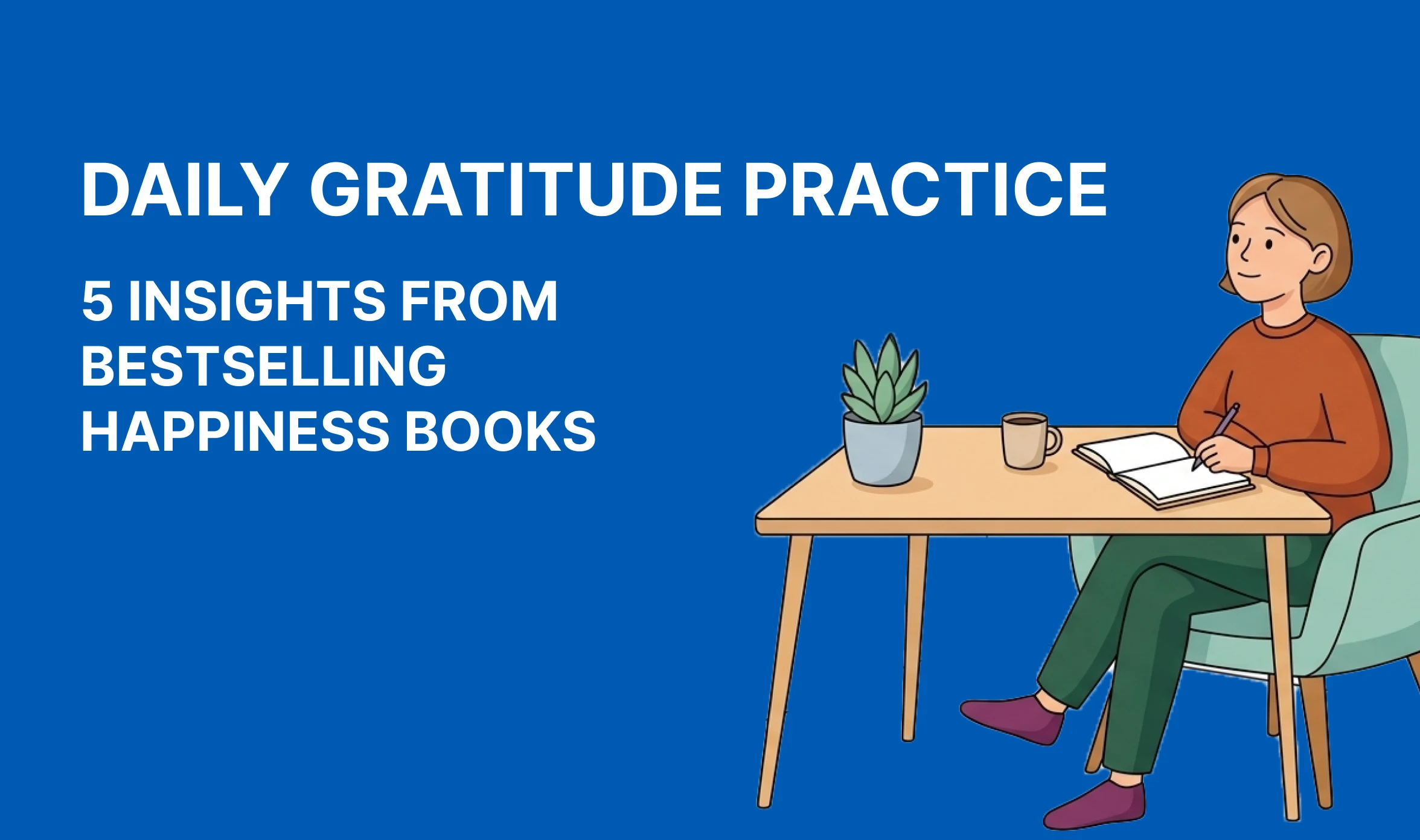
Do you want to be happy? “Well, yeah,” you might say. Daily gratitude practice is perhaps one of the easiest steps you could take. We’ve collected some advice from happiness bestsellers. Shall we start?
Remember your previous pain and be grateful for the small joys now
The practice of gratitude isn’t widely covered in the media, so many people have come to see it as stereotypical. Chances are you’re visualizing a Karen-like character who, at the slightest problem, says to herself with a silly look, “I’m grateful for what I have.” Well, in that case, it’s worth clarifying that the practice of gratitude is much deeper than that. Some researchers believe that true gratitude is only available to those who have known real pain in life. Only someone who’s been hungry can truly appreciate satiety.
The next step is to actually try positive psychology and gratitude in particular. Tara Schuster, the author of Buy Yourself the F*cking Lilies, encourages practicing gratitude even if it feels unnatural at first. Try writing down things you’re thankful for. The easiest way to start is jotting down everyday details, like a good cup of coffee or a quiet moment in the morning. As you continue, you’ll naturally start noticing deeper things, be it meaningful conversations, supportive people in your life, or your health, which is easy to take for granted. The key is consistency and openness. You lose nothing by trying, but you may discover a new, more positive way of seeing your life.

Do not “jinx” it
Many people have heard that you should not say bad things, because you can “jinx.” And although in the 21st century most people don’t buy into superstitions, we still shouldn’t use negative language. Saying something like “I’m such a fool” will really make your brain think you’re a fool. Don’t blame the evil eye, blame cognitive psychology. Although it sounds too cliché, you must learn to use positive words toward yourself. Start your morning by looking in the mirror and saying, “I love myself,” “I can handle this.” It is especially worth doing this if you don’t really believe it. Add this to a few other gratitude rituals for your morning.
Gradually, you can transform how you act and the decisions you make by changing your mindset. Psychologist Carol Dweck proves this in her book Mindset — find out more in our summary of it.

Fake it till you make it
Robert A. Emmons, an American psychologist and professor at UC Davis, notes that when we smile, our bodies automatically produce joy hormones. He found that when individuals activate the “smiling muscles” in their face, it provides the brain with peripheral information that drives a positive emotional experience.
This means that even in the most difficult times, you can try to smile. Of course, a fake smile will never be as valuable as a genuine smile. But hey, just keep smiling. At the end of the day, your brain will believe that you are actually joyful. That’s much better than just waiting to feel better on your own. Happiness is a big and difficult job. So embrace the need to smile as part of that work and practice thankfulness right now.
Appreciate your senses
Through your senses, you can experience what it means to be human. Listen to the laughter of your children, look at the sky during sunset, smell your mom’s cherry pie, and dip your feet in the cold water of a creek. Still, many people in this world do not possess the same set of senses as others. Even if you can’t see, you can still hear music. Or conversely, not being able to hear, you can still look at rainbows.
In the book Thanks! by Robert A. Emmons, there is one telling example. One research participant, a woman who became totally blind, wrote that while she would never choose to be blind, she found “gifts” in her condition. She noted that she was grateful because her lack of sight allowed her to “see the goodness in people” and get “right to their hearts” without being distracted by outward appearances.

Thanks!
Develop your gratitude for resilience
This is another recommendation from Thanks!. Research suggests that regularly practicing gratitude can strengthen psychological resilience, particularly after traumatic experiences. It appears to help individuals recover more effectively from severe stress and manage everyday pressures with greater stability.
One account describes a technology consultant who was inside the South Tower during the 9/11 attacks. He recalled the evacuation as surprisingly orderly, noting that people supported one another through acts of reassurance, care, and physical comfort. Even outside the context of disasters, gratitude can help you boost resilience in more everyday life situations. As a result, you’ll be able to laugh in the face of adversity without succumbing to the tricks of fate and keep a cool head.
Gratitude isn’t a one-time feeling or a moment you reach and then keep forever; it’s something you build and return to again and again. The idea is to treat it as a steady practice that slowly reshapes how you see your life. Over time, this shift leads to a simple but powerful understanding: in this present moment, there is enough, and you are enough.
Credentials
- Photo by Gabrielle Henderson on Unsplash