If you’ve been learning English for a while, you may have experienced this struggle. While you mostly understand movies, have no problem reading articles or following conversations, the moment you start speaking, your confidence shakes. You sound hesitant, or the words don’t flow the way they do in your head. You understand English grammar and vocabulary, but don’t yet own it naturally, sort of like wearing a borrowed coat.
This is one of the most common problem areas in language learning, but it has a surprisingly effective solution: a technique called shadowing.
What is shadowing?
Simply put, shadowing is about listening to a native speaker and repeating what they say almost simultaneously, like an echo. Linguist Alexander Arguelles, who used it to learn multiple languages, popularized the shadowing technique (Professor Arguelles also has a YouTube channel and a website with lots of insightful tips, which we highly recommend checking out!)
With shadowing, you learn to speak just like a child does when acquiring a language. When you shadow, you’re training your muscle memory and forming new physical habits, such as the specific ways English reduces unstressed syllables, links words together (“going to” becoming “gonna”), and places emphasis to carry meaning. These are things you can study intellectually, but you can only truly acquire them through repetition and imitation.

Okay, the principle is clear… but what should you shadow?
What materials can you use for this learning method? Audiobooks are often too long and dense, so it’s difficult to find natural starting and stopping points. Podcasts may move too quickly or contain too much filler and meandering sentences. Movies and TV shows often use overlapping dialogue and colloquial language, which can confuse learners.
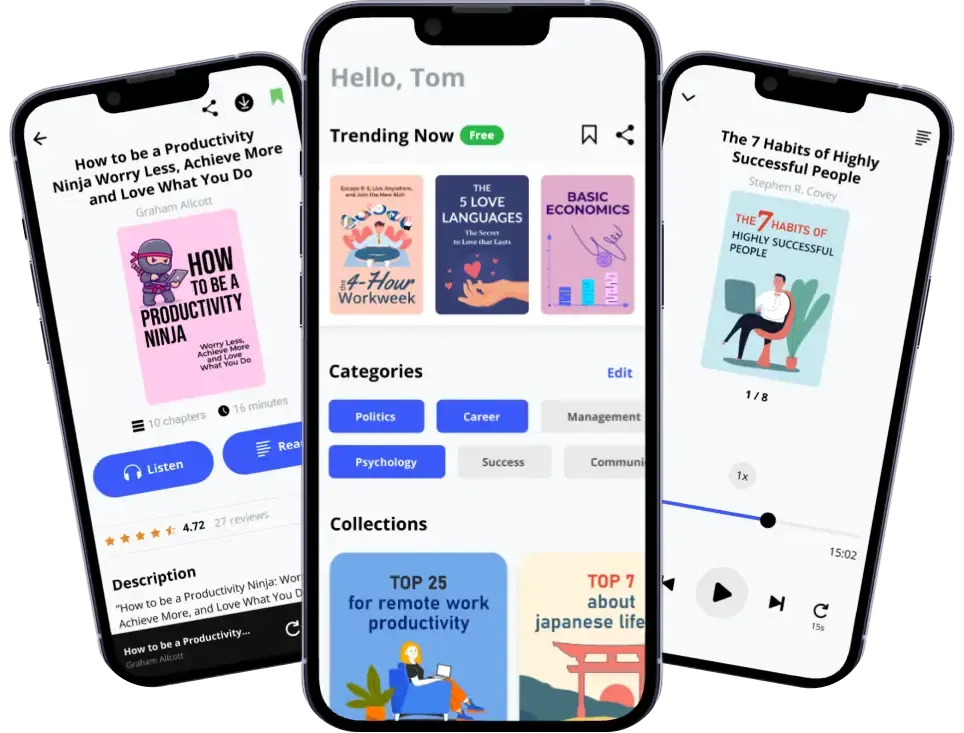
In this sense, book summaries work best: they are clear and well-paced while also short enough for you to stay focused. What’s also crucial is that the written summary accompanies the audio. The text serves as a preparation tool you can read before you even attempt to shadow. This means that when you play the audio, you won’t struggle to understand the content.
The nonfiction register of book summaries exposes you to a level of English that is genuinely useful. Instead of just picking up casual conversational phrases, you’ll be able to absorb the articulate expression that serves you well in various settings. Expand your vocabulary with idioms and phrasal verbs while also discovering new facts and tips across different subjects. For more advice on how to work with book summaries, check out our article.
Step-by-Step English shadowing practice with book summaries
Your shadowing practice doesn’t have to follow a rigid plan; it all depends on how you like to study. Here is a suggested practical routine with all our book summaries:
1. Read the summary first
Let’s say you’ve selected an interesting title. Before listening to anything, read the written summary slowly. Note any unfamiliar words or phrases and look them up. Don’t skip this step, especially if you’re just beginning your shadowing practice.
2. Listen through once for comprehension
Play the audio all the way through without trying to shadow. At first, simply listen. English pronunciation might not always be simple to grasp. Focus on following the meaning and getting a feel for the narrator’s pace and style — the music of a sentence.
3. Shadow in real time
Play the audio again and speak along, trying to stay as close behind the narrator as possible. Don’t stop when you fall behind or stumble — keep going. Focus on matching the melody and rhythm of the sentences rather than getting every single word perfect.
Extra tip: If you find real-time shadowing uncomfortable, pause after each sentence and repeat it. As far as you can, try to mimic the intonation and stress. This slower version is a good entry point for beginners working on pronouncing words.
4. Repeat
It helps to go through the same audio two or three times per session. The more you try, the easier each will feel, and you’ll notice yourself catching details you missed before. Set a practice schedule for yourself so that this practice becomes a part of your studying routine. For instance, have three to five sessions per week, using a different summary each time. Even a 15-minute session will gradually produce noticeable results.

Try it out right now to get the feel of this practice
Here is an excerpt from the first chapter of our summary of So Good They Can’t Ignore You by Cal Newport. Practice using the audio (you can open it in our app) and the text following the plan above.
Read the text once, then play the audio and simply listen. On the second play, speak along — quietly is fine, even a murmur counts. Notice where the narrator’s voice rises and falls and where natural pauses land.
“How often have you heard someone say, “Just follow your passion?” It seems that this piece of advice appears in the majority of self-help books and motivational speeches. This is what Newport calls the Passion Hypothesis: figure out what your passion is and find a job according to it. But if we examine this idea closely, we can see that it’s really flawed.
In his commencement speech at Stanford University, Steve Jobs famously said: “You’ve got to find what you love. If you haven’t found it yet, keep looking, and don’t settle.” This speech went viral, cementing the idea that success comes from following your passion. However, this piece of advice is not a cure-all. Consider this: even Jobs’s path reveals that passion followed success, not vice versa.”
Do it twice, and you’ll already have completed your first shadowing session!
Common mistakes to avoid
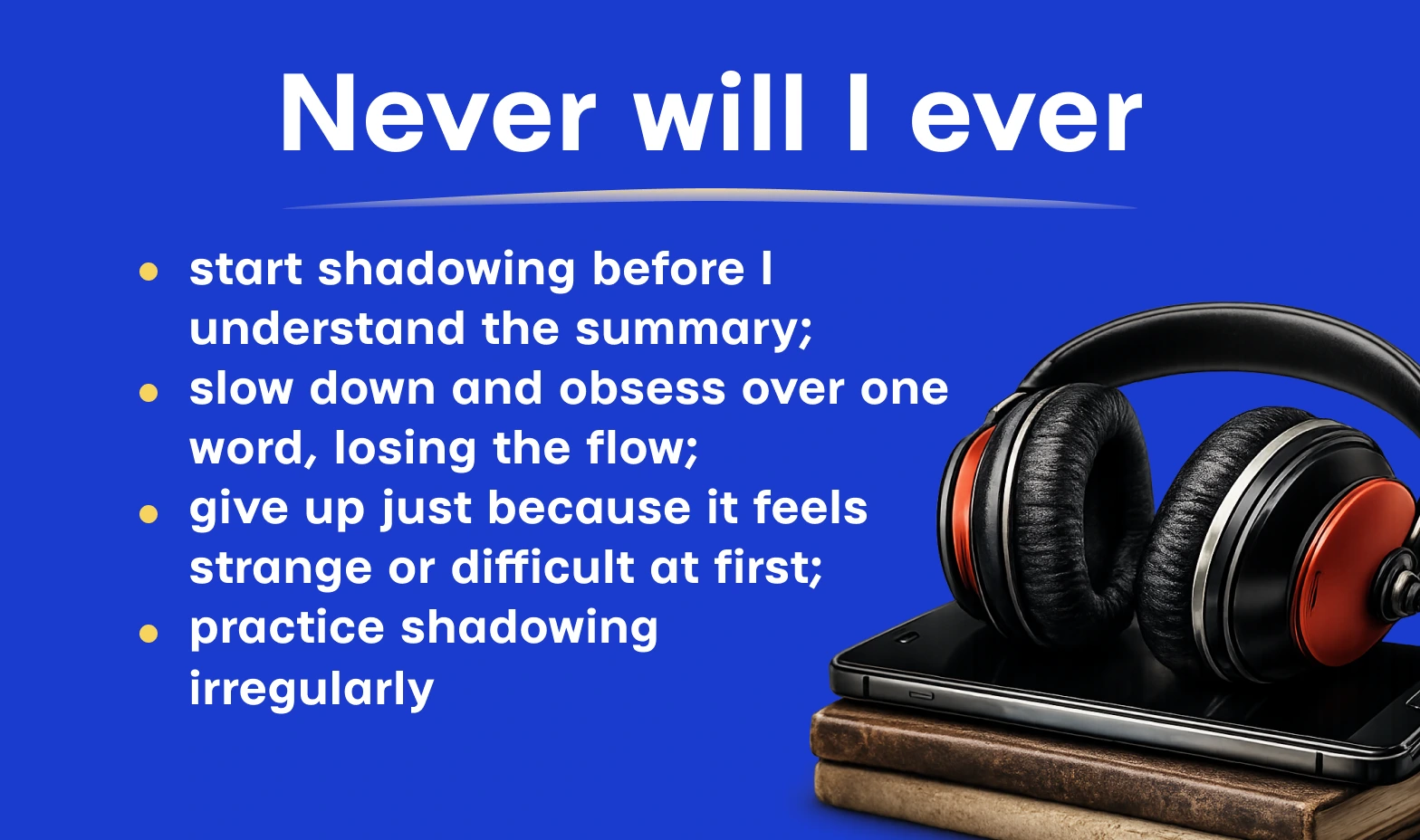
The biggest mistake learners make with shadowing is starting too early. That’s why we highlighted that you shouldn’t put on the audio before you’ve read the summary . If you don’t understand what’s being said, you’re just parroting sounds without building any real language connection.
Another common error is focusing too much on individual words. We use shadowing to capture the flow of whole sentences. And while you may enjoy perfecting the pronunciation of isolated sounds, this won’t make you fluent. If you slow down to obsess over one word, you lose the pattern that makes shadowing valuable.
Many learners also give up too quickly because it feels strange and difficult. Shadowing is genuinely hard at first, but this discomfort is productive! That strangeness is precisely the point. You’re building a new skill, and it will feel awkward before it feels natural. Just stick with it.
Finally, inconsistency is the most common reason shadowing fails to produce results. Like any physical training, it requires regular repetition over time. Doing it occasionally when you feel motivated won’t get you far. You’ve got to show up to the language and commit to regular engagement, even when you don't feel inspired to.
The takeaway
The gap between understanding a language and sounding like a native is real, and it won’t close on its own just by learning more words. English shadowing practice is a fun and easy tool to add to your studying routine. Learn and speak English with the help of AdvanceMe summaries. The written text prepares you before you listen, and the professional narration gives you a reliable model to shadow. Good luck!