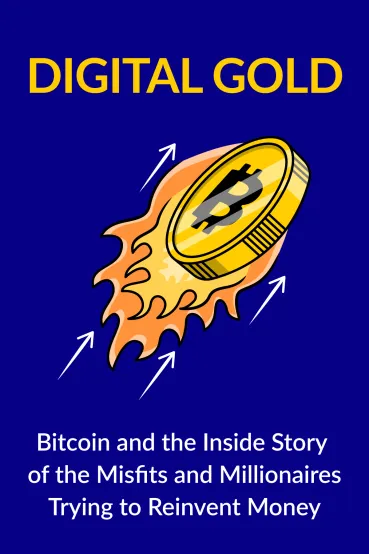
Digital Gold
Brief Summary
“Digital Gold” tells the story of Bitcoin from the start in an easy-to-understand way. If you’re curious how this financial technology came to be and who the people behind it are, this is the book to read.
Key points
Key idea 1 of 6
You’ve probably heard Bitcoin being referred to as “digital gold.” Is this comparison accurate? To understand it, we should trace Bitcoin's origins. It started as a late-night post in 2008 by an anonymous figure known as Satoshi Nakamoto. Satoshi’s primary ambition was to create a form of digital money that mirrored the characteristics of physical gold.
According to his idea, everyone would be able to own and utilize money regardless of where they lived. This coin was designed to be limited in supply, much like gold coins. There was a 21 million-unit limit on its supply, and since producing new coins required significant computing power, it was impossible to counterfeit.
However, unlike heavy gold bars, Bitcoin offered the advantage of global mobility. You could transfer it anywhere with a simple mouse click and a private digital key. Rather than relying on physical security like armed guards, the system’s safety was rooted in extremely secure mathematical algorithms.
This innovative proposal found an immediate audience among the Cypherpunks. It’s a group of activists who had long warned about the risks of the “creeping digitization of life.” People like Hal Finney, an American software developer, feared that governments and major corporations would eventually start systematically gathering data on ordinary citizens. Public-key cryptography allowed users to secure their communications in a way that even powerful supercomputers could not penetrate.
Previous attempts at digital currency, such as David Chaum’s DigiCash, had failed because they relied on a central organization. Meanwhile, Satoshi’s blockchain promised a financial system that would function without a centralized bank or third-party intermediaries. It sounded almost too good to be true — transactions without sharing personal information. But what made it possible?
As a communal database, blockchain tracked every transaction, while people could maintain it in a fully peer-to-peer (P2P) manner. First, users used private keys to sign off on transfers. Then, other network participants verified these transactions and bundled them into “blocks.” Finally, to receive a reward of freshly minted Bitcoin, computers competed to add these blocks to the blockchain. The network could not be controlled or shut down by a single authority because of its organizational structure.
You may also like these summaries