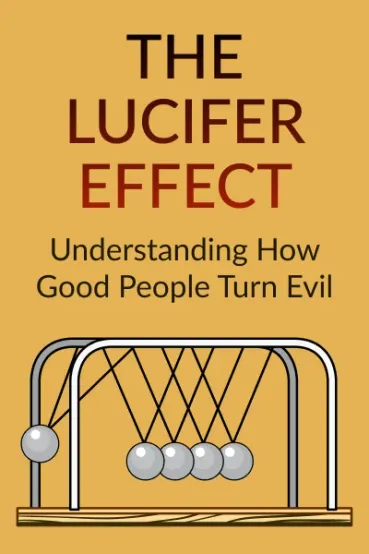
The Lucifer Effect
Brief Summary
Social psychologist and the main figure behind the Stanford Prison Experiment, Philip Zimbardo, presents his bestselling work, where he explains how situational forces blur the fine line between good and evil. If you are intrigued by the question of why ordinary people are capable of cruel decisions, “The Lucifer Effect” will give you all the answers.
Key points
Key idea 1 of 8
The most recognized work of Philip Zimbardo, *The Lucifer Effect*, centers around the question that has troubled many great minds: “What makes good people do bad things?” According to Zimbardo, being an “evil” person entails deliberately hurting others or abusing power and authority.
The “Circle Limit IV” by the Dutch graphic artist M. C. Escher depicts three psychological truths. The first truth is that there is both good and evil. The second one implies that a person can easily cross the line between them. The third truth states that it is possible to go from “angel” to “devil.”
Lucifer — an angel, who was cast out of heaven after trying to overthrow God — is a symbol of this transition. “Cupiditas,” as Lucifer’s sin was called in the Middle Ages, refers to one being solely devoted to oneself. It means that a person sees others as a means to gain what they need or want, refusing love and connection.
The Lucifer Effect indicates that evil is not dispositional, as many assume. It is a common myth that “black sheep” are more inclined to commit harmful acts. Instead, it’s the situational context that has a greater influence on one’s behavior. This theory forms the foundation of Zimbardo’s concept called “System,” a collection of forces that shape the situations in which people act.
Zimbardo explains that our behavior and self-perception stem from familiar situations. An unusual turn of events can reveal that we are capable of cruelty we have never imagined. Whenever we condemn Nazi Germany's concentration camps, the Jonestown mass suicide, or the Rwanda genocide, little do we think that regular people committed all those atrocities.
By believing that we are immune to corruption, we become vulnerable and open to situational manipulation. The thing is, in reality, the gap between good and evil is thin. And if one wants to grasp the core and potential of human behavior fully, they must acknowledge the gravity of situational, systemic, and personal power.
You may also like these summaries