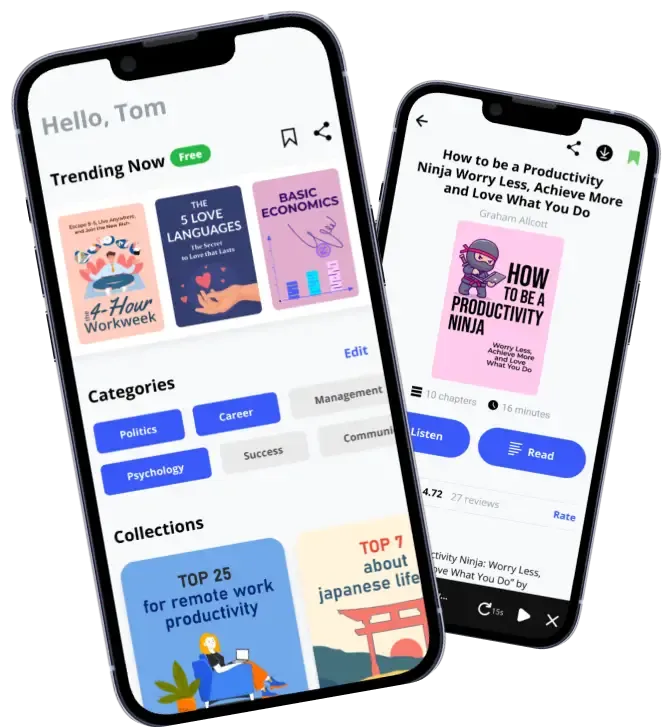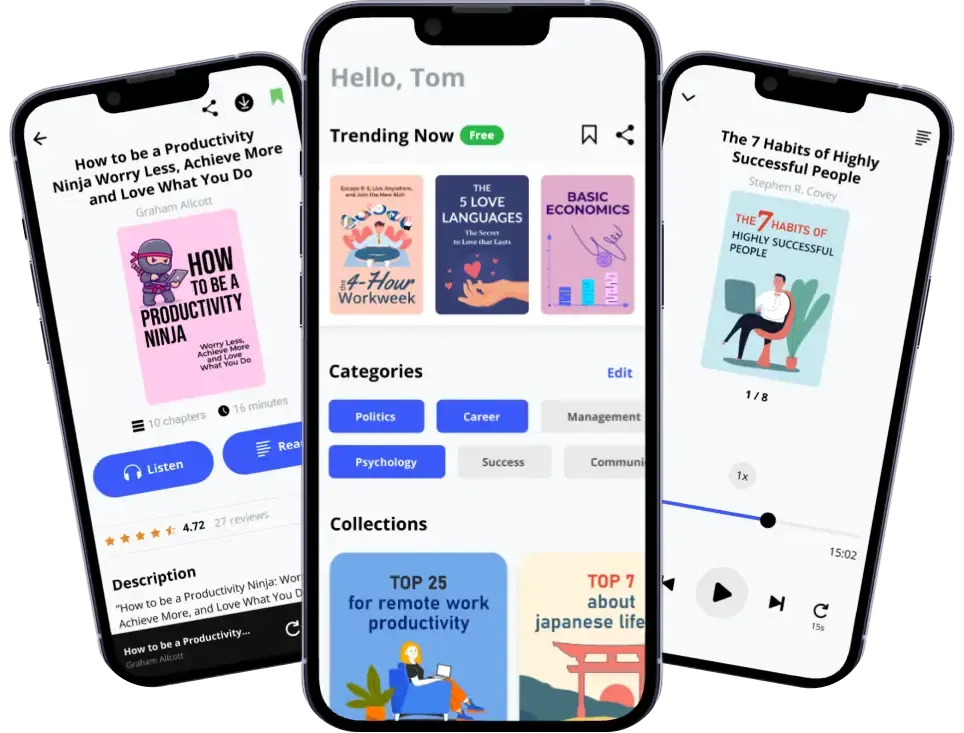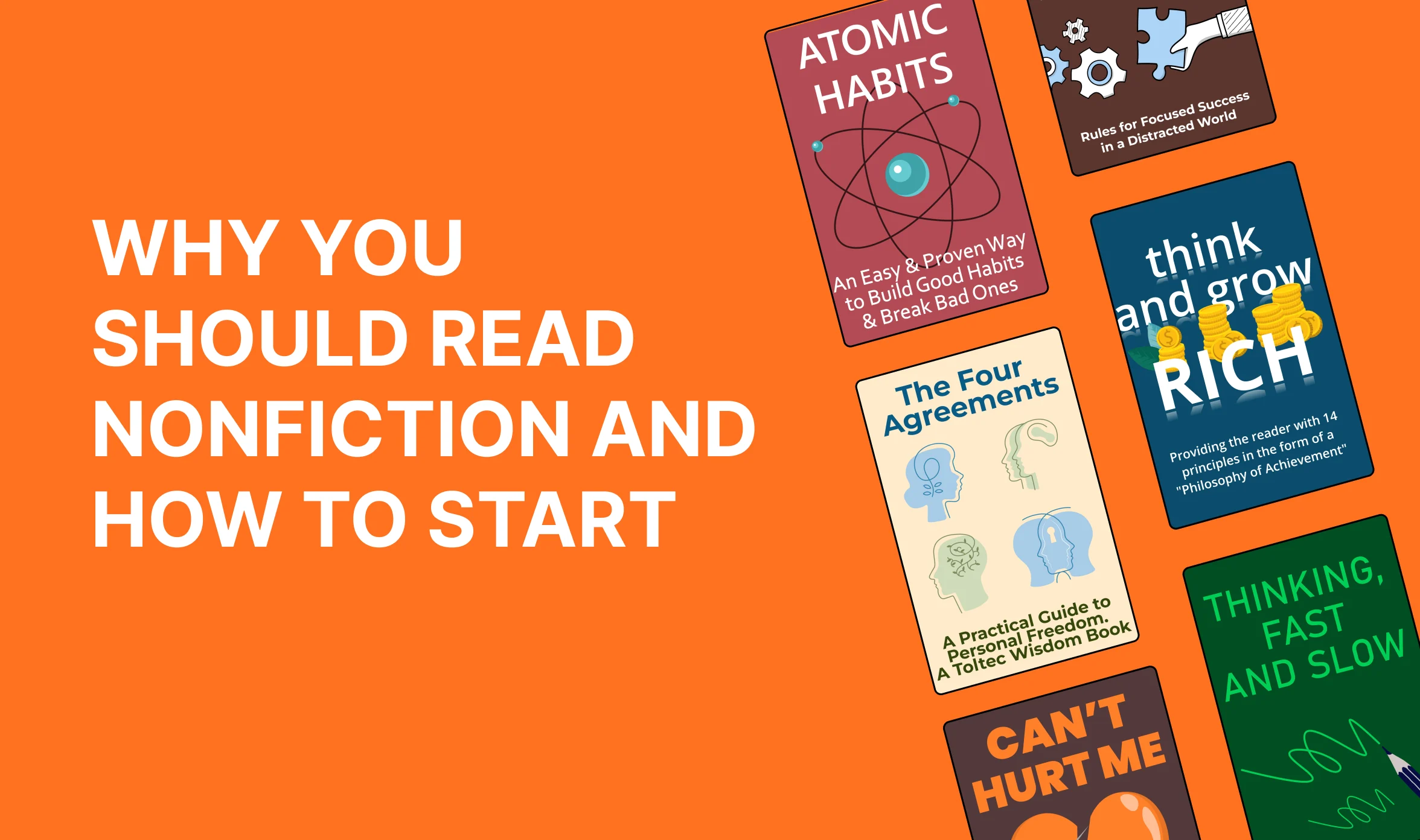
Let's clear something up immediately. Nonfiction is not a genre, but the literature of the real world. True crime and memoirs, psychology and biography, investigative journalism and cultural criticism, economics and personal essays... The people, stakes, and consequences here are real, which makes it even more fascinating. We know what we're talking about because our app, AdvanceMe, specializes in nonfiction summaries.
So, why do we think you can and should take on reading nonfiction?
Top 3 reasons to read nonfiction
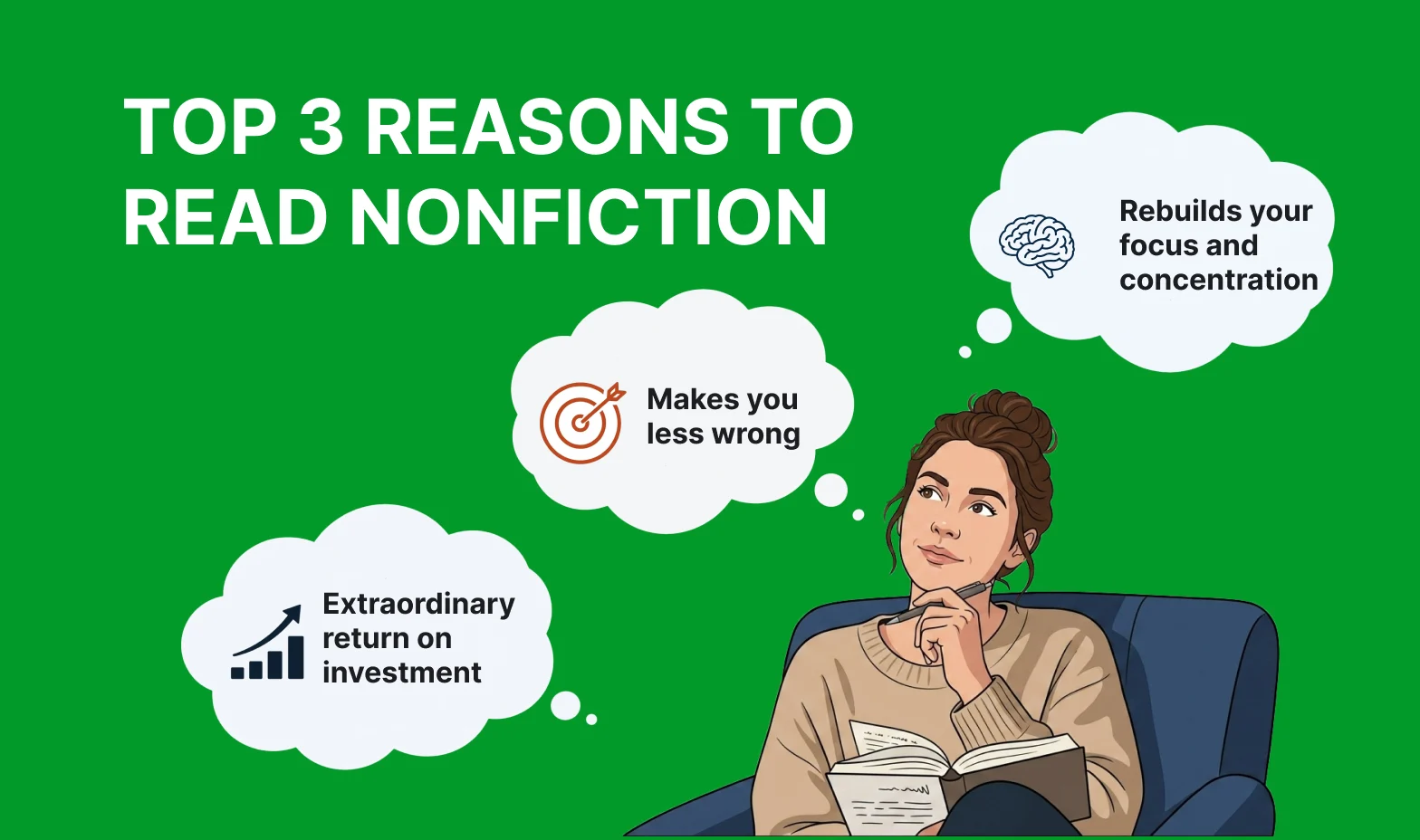
First, the return on investment is extraordinary. For the price of a paperback, you get access to an author's lifetime of expertise, research, mistakes, and hard-won insight. In a week (or even less if you opt for our book summaries), you can read a compressed version of their wisdom. A good nonfiction book means that someone hands you the lessons they spent years or decades learning.
The second argument for reading nonfiction is the fact that it rebuilds your ability to focus. We live in an environment specifically engineered to fragment attention and shallow, rapid consumption. With deep reading, necessary for understanding nonfiction, you develop your cognitive skills. Also, when people return to regular reading after a long break or start reading as a habit, their concentration improves noticeably.
The last and perhaps most underrated reason for getting down to that nonfiction title is the fact that it makes you less wrong. None of us has a complete picture of the world, and those who think they have are actually lying to themselves. We all carry inherited biases and gaps in understanding that we don't even know exist. Reading nonfiction books is one of the most reliable ways to find those gaps and fill them.
Do you feel like reading nonfiction now? Let's break down how you can do it.
How to start reading nonfiction
The most common reason people fall off reading is that they make it harder than it needs to be. Here is what actually works:
Find your itch
The single most important factor in building a reading habit is choosing books you genuinely want to read. Not the books you feel you should read since everybody has done it. Not the books that look impressive on a shelf with an aesthetic cover or catchy title. Choose books about something you are actually interested in — a historical event, a person you admire, a question you've been turning over in your head. When the curiosity is real, the pages turn themselves.
Curiosity is one of the permanent and certain characteristics of a vigorous intellect.
— Samuel Johnson, British writer and lexicographer
Audiobooks count
You don't have to actually read to enjoy nonfiction; the more you think about it, the more you realize that listening to books gives you the same information. What's more, a memoir narrated by its author can feel like a long, intimate conversation. If physical reading isn't working for you right now, audiobooks are a legitimate and often wonderful way to read. And it can happen while you're walking, cooking, commuting, or doing laundry.
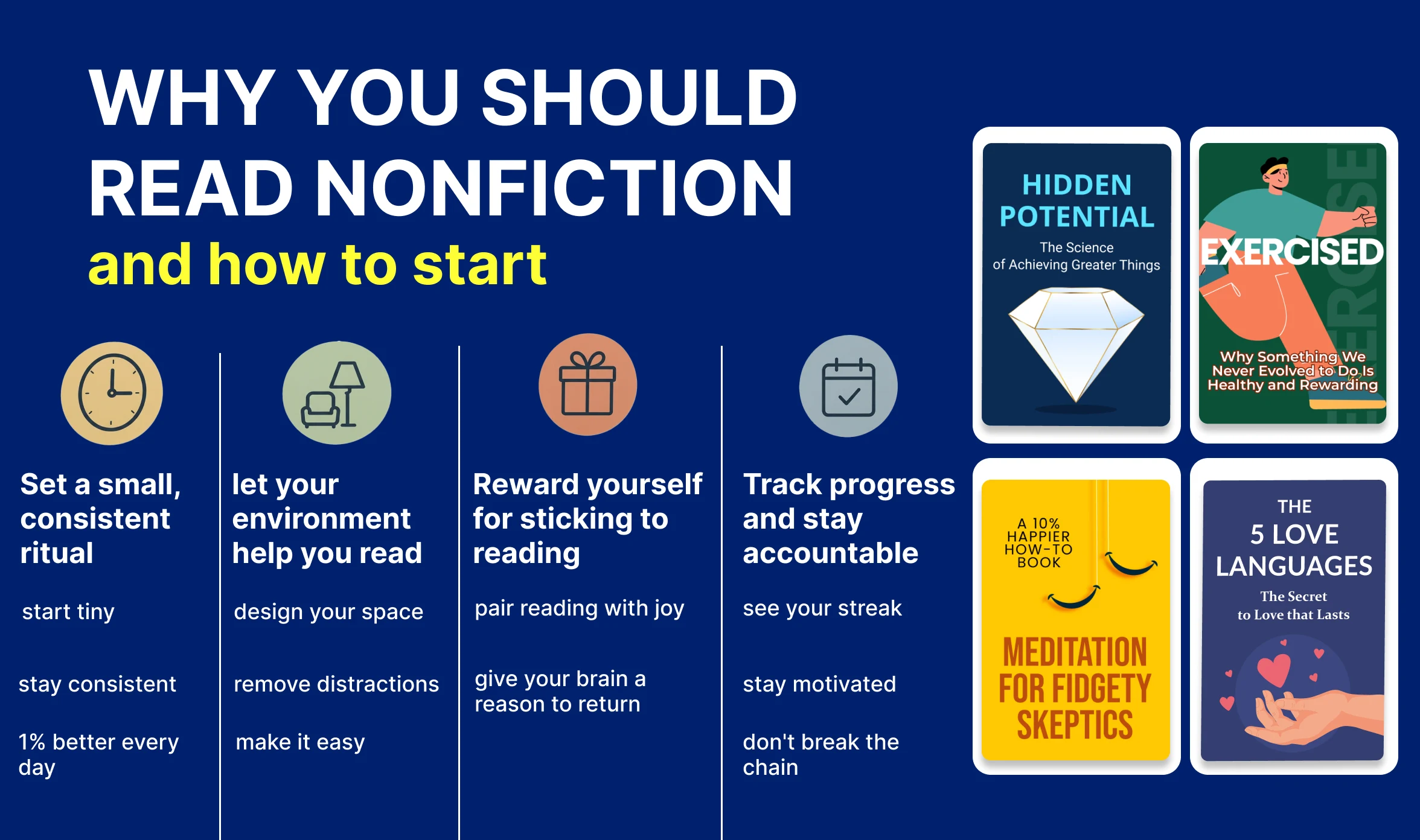
Set a small, consistent ritual
Maybe many of you have heard about Atomic Habits by James Clear. According to it, you can try out a two-minute rule. Start your reading habit by committing to a version that takes less than two minutes, such as reading just one page. Another piece of advice is to strive for 1% daily improvement. Even small, yet consistent actions yield massive results over time. Remember that improving by just 1% each day makes you 37 times better by the end of a year. For more insights, read our book summary of the nonfiction bestseller Atomic Habits.

Let your environment help you read
In The Power of Habit, Charles Duhigg explains that every habit consists of a cue, a routine, and a reward. Thus, the idea here is to identify a specific trigger (like finishing dinner) to start your reading routine. You should also remove any obstacles and distractions, for instance, by switching off your notifications or keeping a book with you at all times. If you are interested in the science of habit development, check out our summary of The Power of Habit.
Reward yourself for sticking to reading
In the previous section, a reward was mentioned as a part of a habit. What does it mean in practice? First, if reading is difficult, pair it with an activity you already love, such as drinking a special favorite tea while you read. Second, our brain craves instant rewards, so give yourself a small treat or use a satisfying ritual immediately after you finish your daily reading. It could be buying yourself a bar of chocolate or watching a new episode of your favorite TV show.
Track progress and stay accountable
Stephen Guise, the author of Mini Habits, mentions that writing down your thoughts and tracking progress makes the habit more "real" in your mind. That's why try using a calendar to mark off each day you read. The thing is that once you see an unbroken chain of successes, it provides a visual cue that motivates you to keep going. But fret not, even if you miss one reading session, just ensure you recover quickly. If any of these tips seem useful, start your nonfiction journey small, with reading or listening to our book summary of Mini Habits.
The nonfiction you can start reading today: our view
If you're not into personal development titles, we've prepared 4 must-read nonfiction books in different categories.
Strangers by Belle Burden (Relationships & Parenting, Biography & Memoir)
Burden's memoir begins with the sudden, cold collapse of her twenty-year marriage after she discovers her husband's affair. What follows is an act of Burden's forensic self-examination. What was the reason for the betrayal? Should she hide her pain from everyone, like many women before her have and are still doing? What were the risks of shaping oneself around another person?
We had all been taught to fill in the hole that men left, to be quiet about men behaving badly, to move on with grace.
— Belle Burden, Strangers: A Memoir of Marriage
London Falling by Patrick Radden Keefe (True crime, Biography & Memoir)

London Falling
London Falling is a great demonstration of investigative journalism. If you enjoy reading thrillers, this book could become your way into the world of nonfiction. The book follows a family's search for truth after the sudden death of their nineteen-year-old son. This search pulls them into a criminal underworld operating just beneath the polished surface of one of the world's most prominent cities. You will feel the grief of the family, feel the city itself, and know it's a story about a real situation, real people.
Famesick by Lena Dunham (Biography & Memoir)

Famesick
What does fame actually do to a person? Dunham's memoir is an attempt to answer just that. This book is funny, but frequently uncomfortable. If you are interested in celebrity culture, mental health, and the cost of making art publicly, this book will tell you.
Looking back, this may be the moment my body started to scream—sure I wouldn't listen, sure I couldn't listen, it took the job upon itself of stopping me in my tracks.
— Lena Dunham, Famesick
Adult Children of Emotionally Immature Parents by Lindsay C. Gibson (Relationships & Parenting; Psychology)

This is one of the most useful books many people will ever read. Gibson, a clinical psychologist, writes for anyone who grew up with a parent who was distant, self-involved, rejecting, or simply not emotionally available. For those who find themselves repeatedly drained by certain relationships, reading this book could become life-saving or at least nerve-saving. Spend 15 minutes reading or listening to our summary of Adult Children of Emotionally Immature Parents and decide if you want to read the whole book.
The best moment to start reading nonfiction is the one you're in right now. Pick the book on this list that makes you most curious, or check out our topics. Open to the first page, and that's the whole method. In case you find it difficult, try following some of the tips above. Good luck, and hopefully we'll see you again.