Slow Productivity
Brief Summary
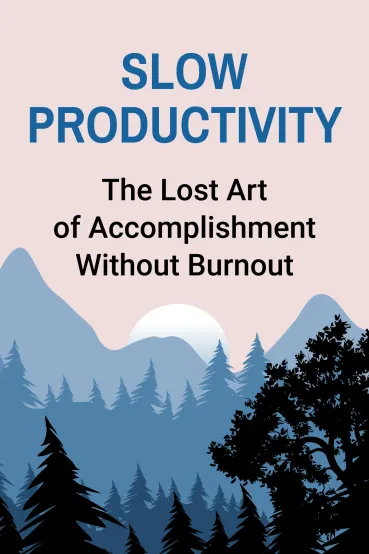
It’s time for you to forget about high productivity in the short term. Thanks to Cal Newport and his concept of slow productivity, you can still achieve your goals, but leave stress and burnout behind. Learn more about slow productivity principles and build a more balanced and fulfilling work life.
Key points
Key idea 1 of 5
Aren’t you fed up with constant productivity seminars? Do you also see hundreds of ads every week on how to do more and more things? The understanding of the productivity concept has changed a lot throughout history. Are we on the verge of a new change in it?
Cal Newport, the author of *Slow Productivity*, talked to 700 knowledge workers. These are workers whose main capital is knowledge: writers, marketers, executives, philosophers, etc. Newport first asked them, “How would most people in your field define productivity or being productive?” The answers were surprising, not because of what people said but because of what they left out. Most responses focused on day-to-day tasks without mentioning clear goals or ways to measure success.
For example, one executive talked about creating content for member groups, a pastor mentioned giving sermons and visiting church members, and a researcher listed meetings and article publications. One engineering director summed up productivity simply as “doing what you said you would do.” All responses stressed how many things people must do to be or feel productive, but not the quality of the work itself. It reveals that employees often don’t have a universal understanding of productivity.
So, we should move from pseudo-productivity to slow productivity. Pseudo-productivity is “the use of visible activity as the primary means of approximating actual productive effort.” Meanwhile, slow productivity is a different approach to work. It helps knowledge workers carry out their tasks without falling into the trap of constant busyness and endless to-do lists. Once we embrace slow productivity, our work will bring purpose, not stress, resulting in real, valuable results.
Slow productivity doesn’t mean we should give up all our ambition. Instead, it offers a more sustainable way to succeed. Slow productivity encompasses three components: doing fewer things, progressing at a steady, organic speed, and prioritizing craftsmanship above all. Just think of Isaac Newton and his *Principia*, which was a real scientific breakthrough. Nobody talks about how long it took him to write this standout work; its quality is what really matters.
You may also like these summaries